Pages

Sunday, 25 December 2011

Life history of Adolf Hitler


Adolf Hitler

(1889-1945)


Adolf Hitler (1889-1945) was the founder and leader of the Nazi Party and the most influential voice in the organization, implementation and execution of the Holocaust, the systematic extermination and ethnic cleansing of six million European Jews and millions of other non-aryans.
Hitler was the Head of State, Supreme Commander of the Armed Forces and guiding spirit, or fuhrer, of Germany's Third Reich from 1933 to 1945.

Early Years
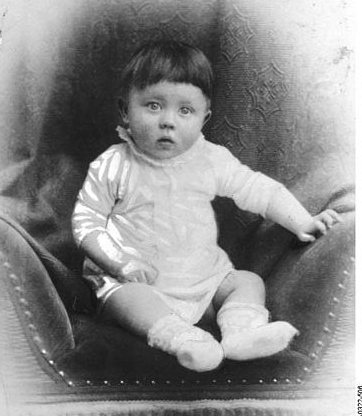
Hitler as a baby
Born in Braunau am Inn, Austria, on April 20, 1889, Hitler was the son of a fifty-two-year-old Austrian customs official, Alois Schickelgruber Hitler, and his third wife, a young peasant girl, Klara Poelzl, both from the backwoods of lower Austria. The young Hitler was a resentful, discontented child. Moody, lazy, of unstable temperament, he was deeply hostile towards his strict, authoritarian father and strongly attached to his indulgent, hard-working mother, whose death from cancer in December 1908 was a shattering blow to the adolescent Hitler.
After spending four years in the Realschule in Linz, he left school at the age of sixteen with dreams of becoming a painter. In October 1907, the provincial, middle-class boy left home for Vienna, where he was to remain until 1913 leading a bohemian, vagabond existence. Embittered at his rejection by the Viennese Academy of Fine Arts, he was to spend "five years of misery and woe" in Vienna as he later recalled, adopting a view of life which changed very little in the ensuing years, shaped as it was by a pathological hatred of Jews and Marxists, liberalism and the cosmopolitan Habsburg monarchy.
Existing from hand to mouth on occasional odd jobs and the hawking of sketches in low taverns, the young Hitler compensated for the frustrations of a lonely bachelor's life in miserable male hostels by political harangues in cheap cafes to anyone who would listen and indulging in grandiose dreams of a Greater Germany.
In Vienna he acquired his first education in politics by studying the demagogic techniques of the popular Christian-social Mayor, Karl Lueger, and picked up the stereotyped, obsessive anti-Semitism with its brutal, violent sexual connotations and concern with the "purity of blood" that remained with him to the end of his career. From crackpot racial theorists like the defrocked monk, Lanz von Liebenfels, and the Austrian Pan-German leader, Georg von Schoenerer, the young Hitler learned to discern in the "Eternal Jew" the symbol and cause of all chaos, corruption and destruction in culture, politics and the economy. The press, prostitution, syphilis, capitalism, Marxism, democracy and pacifism--all were so many means which "the Jew" exploited in his conspiracy to undermine the German nation and the purity of the creative Aryan race.

World War I
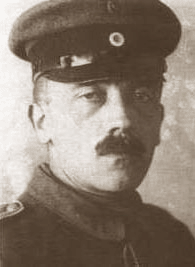
Hitler as a soldier during World War 1 (circa 1915)
In May 1913 Hitler left Vienna for Munich and, when war broke out in August 1914, he joined the Sixteenth Bavarian Infantry Regiment, serving as a despatch runner. Hitler proved an able, courageous soldier, receiving the Iron Cross (First Class) for bravery, but did not rise above the rank of Lance Corporal. Twice wounded, he was badly gassed four weeks before the end of the war and spent three months recuperating in a hospital in Pomerania. Temporarily blinded and driven to impotent rage by the abortive November 1918 revolution in Germany as well as the military defeat, Hitler, once restored, was convinced that fate had chosen him to rescue a humiliated nation from the shackles of the Versailles Treaty, from Bolsheviks and Jews.
Assigned by the Reichswehr in the summer of 1919 to "educational" duties which consisted largely of spying on political parties in the overheated atmosphere of post-revolutionary Munich, Hitler was sent to investigate a small nationalistic group of idealists, the German Workers' Party. On 16 September 1919 he entered the Party (which had approximately forty members), soon changed its name to the National Socialist German Workers' Party (NSDAP) and had imposed himself as its Chairman by July 1921.

Hitler Becomes a Leader

Hitler discovered a powerful talent for oratory as well as giving the new Party its symbol — the swastika — and its greeting "Heil!." His hoarse, grating voice, for all the bombastic, humourless, histrionic content of his speeches, dominated audiences by dint of his tone of impassioned conviction and gift for self-dramatization. By November 1921 Hitler was recognized as Fuhrer of a movement which had 3,000 members, and boosted his personal power by organizing strong- arm squads to keep order at his meetings and break up those of his opponents. Out of these squads grew the storm troopers (SA) organized by Captain Ernst Röhm and Hitler's black-shirted personal bodyguard, the Schutzstaffel (SS).
Hitler focused his propaganda against the Versailles Treaty, the "November criminals," the Marxists and the visible, internal enemy No. 1, the "Jew," who was responsible for all Germany's domestic problems. In the twenty-five-point programme of the NSDAP announced on 24 February 1920, the exclusion of the Jews from the Volk community, the myth of Aryan race supremacy and extreme nationalism were combined with "socialistic" ideas of profit-sharing and nationalization inspired by ideologues like Gottfried Feder. Hitler's first written utterance on political questions dating from this period emphasized that what he called "the anti-Semitism of reason" must lead "to the systematic combating and elimination of Jewish privileges. Its ultimate goal must implacably be the total removal of the Jews."
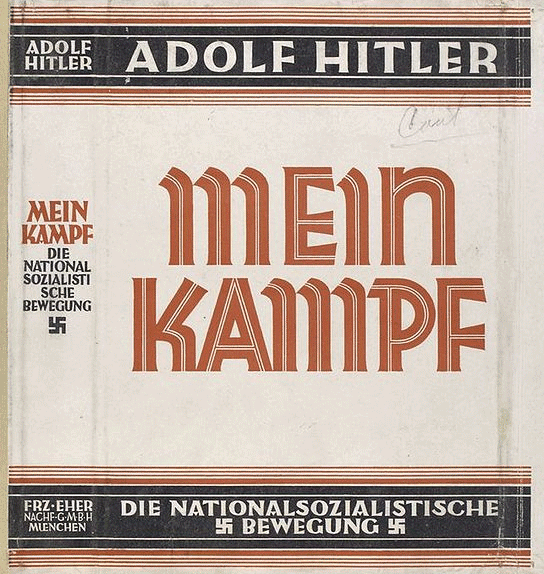
Cover of Hitler's treatise, Mein Kampf
By November 1923 Hitler was convinced that the Weimar Republic was on the verge of collapse and, together with General Ludendorff and local nationalist groups, sought to overthrow the Bavarian government in Munich. Bursting into a beer-hall in Munich and firing his pistol into the ceiling, he shouted out that he was heading a new provisional government which would carry through a revolution against "Red Berlin." Hitler and Ludendorff then marched through Munich at the head of 3,000 men, only to be met by police fire which left sixteen dead and brought the attempted putsch to an ignominious end. Hitler was arrested and tried on 26 February 1924, succeeding in turning the tables on his accusers with a confident, propagandist speech which ended with the prophecy: "Pronounce us guilty a thousand times over: the goddess of the eternal court of history will smile and tear to pieces the State Prosecutor's submission and the court's verdict for she acquits us." Sentenced to five years' imprisonment in Landsberg fortress, Hitler was released after only nine months during which he dictated Mein Kampf (My Struggle) to his loyal follower, Rudolf Hess. Subsequently the "bible" of the Nazi Party, this crude, half-baked hotchpotch of primitive Social Darwinism, racial myth, anti-Semitism and lebensraum fantasy had sold over five million copies by 1939 and been translated into eleven languages.
The failure of the Beer-Hall putsch and his period of imprisonment transformed Hitler from an incompetent adventurer into a shrewd political tactician, who henceforth decided that he would never again confront the gun barrels of army and police until they were under his command. He concluded that the road to power lay not through force alone but through legal subversion of the Weimar Constitution, the building of a mass movement and the combination of parliamentary strength with extra-parliamentary street terror and intimidation. Helped by Goering and Goebbels he began to reassemble his followers and rebuild the movement which had disintegrated in his absence.

Rise of the Nazi Party

In January 1925 the ban on the Nazi Party was removed and Hitler regained permission to speak in public. Outmaneuvering the "socialist" North German wing of the Party under Gregor Strasser, Hitler re-established himself in 1926 as the ultimate arbiter to whom all factions appealed in an ideologically and socially heterogeneous movement. Avoiding rigid, programmatic definitions of National Socialism which would have undermined the charismatic nature of his legitimacy and his claim to absolute leadership, Hitler succeeded in extending his appeal beyond Bavaria and attracting both Right and Left to his movement.
Though the Nazi Party won only twelve seats in the 1928 elections, the onset of the Great Depression with its devastating effects on the middle classes helped Hitler to win over all those strata in German society who felt their economic existence was threatened. In addition to peasants, artisans, craftsmen, traders, small businessmen, ex-officers, students and declasse intellectuals, the Nazis in 1929 began to win over the big industrialists, nationalist conservatives and army circles. With the backing of the press tycoon, Alfred Hugenberg, Hitler received a tremendous nationwide exposure just as the effects of the world economic crisis hit Germany, producing mass unemployment, social dissolution, fear and indignation. With demagogic virtuosity, Hitler played on national resentments, feelings of revolt and the desire for strong leadership using all the most modern techniques of mass persuasion to present himself as Germany's redeemer and messianic saviour.
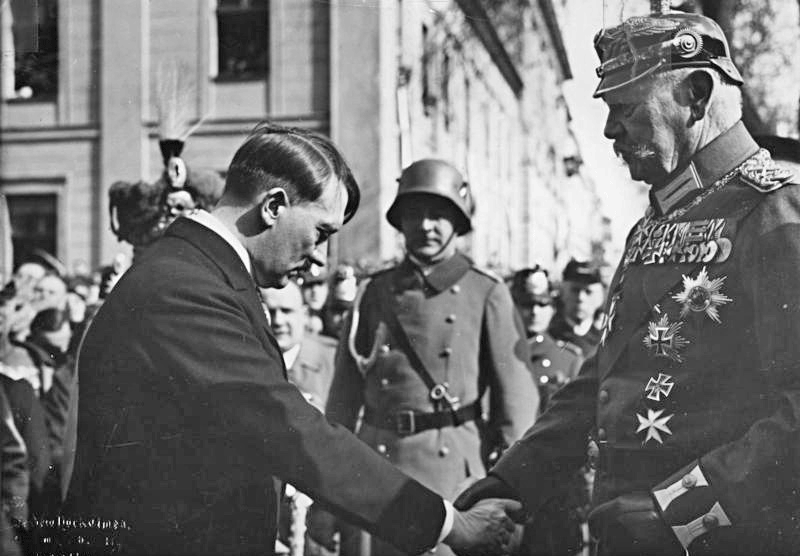
Hitler and President von Hindenburg (1933)
In the 1930 elections the Nazi vote jumped dramatically from 810,000 to 6,409,000 (18.3 percent of the total vote) and they received 107 seats in the Reichstag. Prompted by Hjalmar Schacht and Fritz Thyssen, the great industrial magnates began to contribute liberally to the coffers of the NSDAP, reassured by Hitler's performance before the Industrial Club in Dusseldorf on 27 January 1932 that they had nothing to fear from the radicals in the Party. The following month Hitler officially acquired German citizenship and decided to run for the Presidency, receiving 13,418,011 votes in the run-off elections of 10 April 1931 as against 19,359,650 votes for the victorious von Hindenburg , but four times the vote for the communist candidate, Ernst Thaelmann. In the Reichstag elections of July 1932 the Nazis emerged as the largest political party in Germany, obtaining nearly fourteen million votes (37.3 per cent) and 230 seats. Although the NSDAP fell back in November 1932 to eleven million votes (196 seats), Hitler was helped to power by a camarilla of conservative politicians led by Franz von Papen, who persuaded the reluctant von Hindenburg to nominate "the Bohemian corporal" as Reich Chancellor on 30 January 1933.
Once in the saddle, Hitler moved with great speed to outmanoeuvre his rivals, virtually ousting the conservatives from any real participation in government by July 1933, abolishing the free trade unions, eliminating the communists, Social Democrats and Jews from any role in political life and sweeping opponents into concentration camps. The Reichstag fire of 27 February 1933 had provided him with the perfect pretext to begin consolidating the foundations of a totalitarian one-party State, and special "enabling laws" were ramrodded through the Reichstag to legalize the regime's intimidatory tactics.
With support from the nationalists, Hitler gained a majority at the last "democratic" elections held in Germany on 5 March 1933 and with cynical skill he used the whole gamut of persuasion, propaganda, terror and intimidation to secure his hold on power. The seductive notions of "National Awakening" and a "Legal Revolution" helped paralyse potential opposition and disguise the reality of autocratic power behind a facade of traditional institutions.

Hitler As Fuhrer

Hitler after an SS rally in Berlin
The destruction of the radical SA leadership under Ernst Rohm in the Blood Purge of June 1934 confirmed Hitler as undisputed dictator of the Third Reich and by the beginning of August, when he united the positions of Fuhrer and Chancellor on the death of von Hindenburg, he had all the powers of State in his hands. Avoiding any institutionalization of authority and status which could challenge his own undisputed position as supreme arbiter, Hitler allowed subordinates like Himmler, Goering and Goebbels to mark out their own domains of arbitrary power while multiplying and duplicating offices to a bewildering degree.
During the next four years Hitler enjoyed a dazzling string of domestic and international successes, outwitting rival political leaders abroad just as he had defeated his opposition at home. In 1935 he abandoned the Versailles Treaty and began to build up the army by conscripting five times its permitted number. He persuaded Great Britain to allow an increase in the naval building programme and in March 1936 he occupied the demilitarized Rhineland without meeting opposition. He began building up the Luftwaffe and supplied military aid to Francoist forces in Spain, which brought about the Spanish fascist victory in 1939.
The German rearmament programme led to full employment and an unrestrained expansion of production, which reinforced by his foreign policy successes--the Rome-Berlin pact of 1936, the Anschluss with Austria and the "liberation" of the Sudeten Germans in 1938 — brought Hitler to the zenith of his popularity. In February 1938 he dismissed sixteen senior generals and took personal command of the armed forces, thus ensuring that he would be able to implement his aggressive designs.
Hitler's saber-rattling tactics bludgeoned the British and French into the humiliating Munich agreement of 1938 and the eventual dismantlement of the Czechoslovakian State in March 1939. The concentration camps, the Nuremberg racial laws against the Jews, the persecution of the churches and political dissidents were forgotten by many Germans in the euphoria of Hitler's territorial expansion and bloodless victories. The next designated target for Hitler's ambitions was Poland (her independence guaranteed by Britain and France) and, to avoid a two-front war, the Nazi dictator signed a pact of friendship and non-aggression with Soviet Russia.

World War II

On September 1, 1939, German armed forces invaded Poland and henceforth Hitler's main energies were devoted to the conduct of a war he had unleashed to dominate Europe and secure Germany's "living space."
The first phase of World War II was dominated by German Blitzkrieg tactics: sudden shock attacks against airfields, communications, military installations, using fast mobile armor and infantry to follow up on the first wave of bomber and fighter aircraft. Poland was overrun in less than one month, Denmark and Norway in two months, Holland, Belgium, Luxemburg and France in six weeks. After the fall of France in June 1940 only Great Britain stood firm.
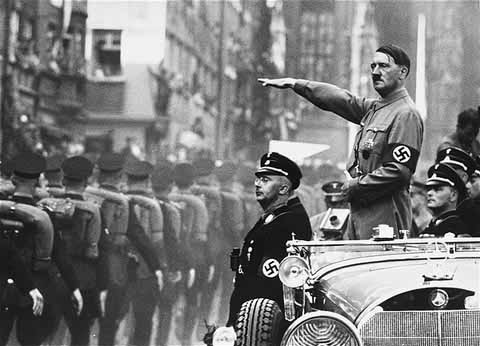
Hitler showing the Nazi salute
The Battle of Britain, in which the Royal Air Force prevented the Luftwaffe from securing aerial control over the English Channel, was Hitler's first setback, causing the planned invasion of the British Isles to be postponed. Hitler turned to the Balkans and North Africa where his Italian allies had suffered defeats, his armies rapidly overrunning Greece, Yugoslavia, the island of Crete and driving the British from Cyrenaica.
The crucial decision of his career, the invasion of Soviet Russia on June 22, 1941, was rationalized by the idea that its destruction would prevent Great Britain from continuing the war with any prospect of success. He was convinced that once he kicked the door in, as he told Jodl (q.v.), "the whole rotten edifice [of communist rule] will come tumbling down" and the campaign would be over in six weeks. The war against Russia was to be an anti-Bolshivek crusade, a war of annihilation in which the fate of European Jewry would finally be sealed. At the end of January 1939 Hitler had prophesied that "if the international financial Jewry within and outside Europe should succeed once more in dragging the nations into a war, the result will be, not the Bolshevization of the world and thereby the victory of Jewry, but the annihilation of the Jewish race in Europe."
As the war widened — the United States by the end of 1941 had entered the struggle against the Axis powers — Hitler identified the totality of Germany's enemies with "international Jewry," who supposedly stood behind the British-American-Soviet alliance. The policy of forced emigration had manifestly failed to remove the Jews from Germany's expanded lebensraum, increasing their numbers under German rule as the Wehrmacht moved East.
The widening of the conflict into a world war by the end of 1941, the refusal of the British to accept Germany's right to continental European hegemony (which Hitler attributed to "Jewish" influence) and to agree to his "peace" terms, the racial-ideological nature of the assault on Soviet Russia, finally drove Hitler to implement the "Final Solution of the Jewish Question" which had been under consideration since 1939. The measures already taken in those regions of Poland annexed to the Reich against Jews (and Poles) indicated the genocidal implications of Nazi-style "Germanization" policies. The invasion of Soviet Russia was to set the seal on Hitler's notion of territorial conquest in the East, which was inextricably linked with annihilating the 'biological roots of Bolshevism' and hence with the liquidation of all Jews under German rule.
At first the German armies carried all before them, overrunning vast territories, overwhelming the Red Army, encircling Leningrad and reaching within striking distance of Moscow. Within a few months of the invasion Hitler's armies had extended the Third Reich from the Atlantic to the Caucasus, from the Baltic to the Black Sea. But the Soviet Union did not collapse as expected and Hitler, instead of concentrating his attack on Moscow, ordered a pincer movement around Kiev to seize the Ukraine, increasingly procrastinating and changing his mind about objectives. Underestimating the depth of military reserves on which the Russians could call, the caliber of their generals and the resilient, fighting spirit of the Russian people (whom he dismissed as inferior peasants), Hitler prematurely proclaimed in October 1941 that the Soviet Union had been "struck down and would never rise again." In reality he had overlooked the pitiless Russian winter to which his own troops were now condemned and which forced the Wehrmacht to abandon the highly mobile warfare which had previously brought such spectacular successes.
The disaster before Moscow in December 1941 led him to dismiss his Commander-in-Chief von Brauchitsch, and many other key commanders who sought permission for tactical withdrawals, including Guderian, Bock, Hoepner, von Rundstedt and Leeb, found themselves cashiered. Hitler now assumed personal control of all military operations, refusing to listen to advice, disregarding unpalatable facts and rejecting everything that did not fit into his preconceived picture of reality. His neglect of the Mediterranean theatre and the Middle East, the failure of the Italians, the entry of the United States into the war, and above all the stubborn determination of the Russians, pushed Hitler on to the defensive. From the winter of 1941 the writing was on the wall but Hitler refused to countenance military defeat, believing that implacable will and the rigid refusal to abandon positions could make up for inferior resources and the lack of a sound overall strategy.
Convinced that his own General Staff was weak and indecisive, if not openly treacherous, Hitler became more prone to outbursts of blind, hysterical fury towards his generals, when he did not retreat into bouts of misanthropic brooding. His health, too, deteriorated under the impact of the drugs prescribed by his quack physician, Dr. Theodor Morell. Hitler's personal decline, symbolized by his increasingly rare public appearances and his self-enforced isolation in the "Wolf's Lair," his headquarters buried deep in the East Prussian forests, coincided with the visible signs of the coming German defeat which became apparent in mid-1942.

Allied Victory and Hitler's Death

Rommel's defeat at El Alamein and the subsequent loss of North Africa to the Anglo-American forces were overshadowed by the disaster at Stalingrad where General von Paulus's Sixth Army was cut off and surrendered to the Russians in January 1943. In July 1943 the Allies captured Sicily and Mussolini's regime collapsed in Italy. In September the Italians signed an armistice and the Allies landed at Salerno, reaching Naples on 1 October and taking Rome on June 4, 1944. The Allied invasion of Normandy followed on June 6, 1944 and soon a million Allied troops were driving the German armies eastwards, while from the opposite direction the Soviet forces advanced relentlessly on the Reich. The total mobilization of the German war economy under Albert Speer and the energetic propaganda efforts of Joseph Goebbels to rouse the fighting spirit of the German people were impotent to change the fact that the Third Reich lacked the resources equal to a struggle against the world alliance which Hitler himself had provoked.
Front Page of US Army newspaper announcing Hitlers death (1945)
Allied bombing began to have a telling effect on German industrial production and to undermine the morale of the population. The generals, frustrated by Hitler's total refusal to trust them in the field and recognizing the inevitability of defeat, planned, together with the small anti-Nazi Resistance inside the Reich, to assassinate the Fuhrer on 20 July 1944, hoping to pave the way for a negotiated peace with the Allies that would save Germany from destruction. The plot failed and Hitler took implacable vengeance on the conspirators, watching with satisfaction a film of the grisly executions carried out on his orders.
As disaster came closer, Hitler buried himself in the unreal world of the Fuhrerbunker in Berlin, clutching at fantastic hopes that his "secret weapons," the V-1 and V-2 rockets, would yet turn the tide of war. He gestured wildly over maps, planned and directed attacks with non-existent armies and indulged in endless, night-long monologues which reflected his growing senility, misanthropy and contempt for the "cowardly failure" of the German people.
As the Red Army approached Berlin and the Anglo-Americans reached the Elbe, on 19 March 1945 Hitler ordered the destruction of what remained of German industry, communications and transport systems. He was resolved that, if he did not survive, Germany too should be destroyed. The same ruthless nihilism and passion for destruction which had led to the extermination of six million Jews in death camps, to the biological "cleansing" of the sub-human Slavs and other subject peoples in the New Order, was finally turned on his own people.
On April 29, 1945, he married his mistress Eva Braun and dictated his final political testament, concluding with the same monotonous, obsessive fixation that had guided his career from the beginning: "Above all I charge the leaders of the nation and those under them to scrupulous observance of the laws of race and to merciless opposition to the universal poisoner of all peoples, international Jewry."
The following day Hitler committed suicide, shooting himself through the mouth with a pistol. His body was carried into the garden of the Reich Chancellery by aides, covered with petrol and burned along with that of Eva Braun. This final, macabre act of self-destruction appropriately symbolized the career of a political leader whose main legacy to Europe was the ruin of its civilization and the senseless sacrifice of human life for the sake of power and his own commitment to the bestial nonsense of National Socialist race mythology. With his death nothing was left of the "Greater Germanic Reich," of the tyrannical power structure and ideological system which had devastated Europe during the twelve years of his totalitarian rule.

Joseph Stalin biography

Quick Facts

  • NAME: Joseph Stalin
  • OCCUPATION: Dictator
  • BIRTH DATE: December 18, 1878
  • DEATH DATE: March 05, 1953
  • PLACE OF BIRTH: Gori, Tiflis Governorate
more about Joseph

Best Known For

Joseph Stalin, the first General Secretary of the Communist Party, took over after Vladimir Lenin's death and became the leader of the Soviet Union.

Joseph Stalin (b. December 18, 1878 in the Russian Empire) served as the first General Secretary of the Communist Party of the Soviet Union's Central Committee from 1922 until his death in 1953. Stalin assumed the leading role in Soviet politics after Vladimir Lenin's death in 1924, and gradually marginalized his opponents until he had become the unchallenged leader of the Soviet Union.

Profile

(born Dec. 18, 1879, Gori, Georgia, Russian Empire—died March 5, 1953, Moscow, Russia, U.S.S.R.) Soviet politician and dictator. The son of a cobbler, he studied at a seminary but was expelled for revolutionary activity in 1899. He joined an underground revolutionary group and sided with the Bolshevik faction of the Russian Social-Democratic Workers' Party in 1903. A disciple of Vladimir Lenin, he served in minor party posts and was appointed to the first Bolshevik Central Committee (1912). He remained active behind the scenes and in exile (1913–17) until the Russian Revolution of 1917 brought the Bolsheviks to power. Having adopted the name Stalin (from Russian stal, “steel”), he served as commissar for nationalities and for state control in the Bolshevik government (1917–23). He was a member of the Politburo, and in 1922 he became secretary-general of the party's Central Committee. After Lenin's death (1924), Stalin overcame his rivals, including Leon Trotsky, Grigory Zinovyev, Lev Kamenev, Nikolay Bukharin, and Aleksey Rykov, and took control of Soviet politics. In 1928 he inaugurated the Five-Year Plans that radically altered Soviet economic and social structures and resulted in the deaths of many millions. In the 1930s he contrived to eliminate threats to his power through the purge trials and through widespread secret executions and persecution. In World War II he signed the German-Soviet Nonaggression Pact (1939), attacked Finland ( Russo-Finnish War), and annexed parts of eastern Europe to strengthen his western frontiers. When Germany invaded Russia (1941), Stalin took control of military operations. He allied Russia with Britain and the U.S.; at the Tehrn, Yalta, and Potsdam conferences, he demonstrated his negotiating skill. After the war he consolidated Soviet power in eastern Europe and built up the Soviet Union as a world military power. He continued his repressive political measures to control internal dissent; increasingly paranoid, he was preparing to mount another purge after the so-called Doctors' Plot when he died. Noted for bringing the Soviet Union into world prominence, at terrible cost to his own people, he left a legacy of repression and fear as well as industrial and military power. In 1956 Stalin and his personality cult were denounced by Nikita Khrushchev.

Jawaharlal Nehru Biography

Born: November 14, 1889
Died: May 27, 1964
Achievements: Took active part in Non-Cooperation Movement; elected President of the Allahabad Municipal Corporation in 1924, and served for two years as the city's chief executive; Presided over Congress' annual session in Lahore in 1929 and passed a resolution demanding India's independence; elected as Congress President in 1936, 1937, and 1946; became first Prime Minister of independent India; was one of the main architects of Non Aligned Movement.

Jawaharlal Nehru, also known as Pandit Jawaharlal Nehru, was one of the foremost leaders of Indian freedom struggle. He was the favourite disciple of Mahatma Gandhi and later on went on to become the first Prime Minister of India. Jawahar Lal Nehru is widely regarded as the architect of modern India. He was very fond of children and children used to affectionately call him Chacha Nehru.

Jawahar Lal Nehru was born on November 14, 1889. His father Motilal Nehru was a famous Allahabad based barrister. Jawaharlal Nehru's mother's name was Swaroop Rani. Jawaharlal Nehru was the only son of Motilal Nehru. Motilal Nehru has three daughters apart from Jawaharlal Nehru. Nehrus were Saraswat Brahmin of Kashmiri lineage.

Jawaharlal Nehru received education in some of the finest schools and universities of the world. He did his schooling from Harrow and completed his Law degree from Trinity College, Cambridge. The seven years he spent in England widened his horizons and he acquired a rational and skeptical outlook and sampled Fabian socialism and Irish nationalism, which added to his own patriotic dedication.

Jawaharlal Nehru returned to India in 1912 and started legal practice. He married Kamala Nehru in 1916. Jawahar Lal Nehru joined Home Rule League in 1917. His real initiation into politics came two years later when he came in contact with Mahatma Gandhi in 1919. At that time Mahatma Gandhi had launched a campaign against Rowlatt Act. Nehru was instantly attracted to Gandhi's commitment for active but peaceful, civil disobedience. Gandhi himself saw promise and India's future in the young Jawaharlal Nehru.

Nehru family changed its family according to Mahatma Gandhi's teachings. Jawaharlal and Motilal Nehru abandoned western clothes and tastes for expensive possessions and pastimes. They now wore a Khadi Kurta and Gandhi cap. Jawaharlal Nehru took active part in the Non- Cooperation Movement 1920-1922) and was arrested for the first time during the movement. He was released after few months.

Jawaharlal Nehru was elected President of the Allahabad Municipal Corporation in 1924, and served for two years as the city's chief executive. This proved to be a valuable administrative experience for stood him in good stead later on when he became the prime minister of the country. He used his tenure to expand public education, health care and sanitation. He resigned in 1926 citing lack of cooperation from civil servants and obstruction from British authorities.

From 1926 to 1928, Jawaharlal served as the General Secretary of the All India Congress Committee. In 1928-29, the Congress's annual session under President Motilal Nehru was held. During that session Jawaharlal Nehru and Subhas Chandra Bose backed a call for full political independence, while Motilal Nehru and others wanted dominion status within the British Empire. To resolve the point, Gandhi said that the British would be given two years to grant India dominion status. If they did not, the Congress would launch a national struggle for full, political independence. Nehru and Bose reduced the time of opportunity to one year. The British did not respond.

In December 1929, Congress's annual session was held in Lahore and Jawaharlal Nehru was elected as the President of the Congress Party. During that sessions a resolution demanding India's independence was passed and on January 26, 1930 in Lahore, Jawaharlal Nehru unfurled free India's flag. Gandhiji gave a call for Civil Disobedience Movement in 1930. The movement was a great success and forced British Government to acknowledge the need for major political reforms.

When the British promulgated the Government of India Act 1935, the Congress Party decided to contest elections. Nehru stayed out of the elections, but campaigned vigorously nationwide for the party. The Congress formed governments in almost every province, and won the largest number of seats in the Central Assembly. Nehru was elected to the Congress presidency in 1936, 1937, and 1946, and came to occupy a position in the nationalist movement second only to that of Gandhi. Jawaharlal Nehru was arrested in 1942 during Quit India Movement. Released in 1945, he took a leading part in the negotiations that culminated in the emergence of the dominions of India and Pakistan in August 1947.

In 1947, he becamethe first Prime Minister of independent India. He effectively coped with the formidable challenges of those times: the disorders and mass exodus of minorities across the new border with Pakistan, the integration of 500-odd princely states into the Indian Union, the framing of a new constitution, and the establishment of the political and administrative infrastructure for a parliamentary democracy.

Jawaharlal Nehru played a key role in building modern India. He set up a Planning Commission, encouraged development of science and technology, and launched three successive five-year plans. His policies led to a sizable growth in agricultural and industrial production. Nehru also played a major role in developing independent India's foreign policy. He called for liquidation of colonialism in Asia and Africa and along with Tito and Nasser, was one of the chief architects of the nonaligned movement. He played a constructive, mediatory role in bringing the Korean War to an end and in resolving other international crises, such as those over the Suez Canal and the Congo, offering India's services for conciliation and international policing. He contributed behind the scenes toward the solution of several other explosive issues, such as those of West Berlin, Austria, and Laos.

But Jawahar Lal Nehru couldn't improve India's relations with Pakistan and China. The Kashmir issue proved a stumbling block in reaching an accord with Pakistan, and the border dispute prevented a resolution with China. The Chinese invasion in 1962, which Nehru failed to anticipate, came as a great blow to him and probably hastened his death. Jawaharlal Nehru died of a heart attack on May 27, 1964.

History of "Srinivasa Ramanujan"

Born: December 22, 1887
Died: April 26, 1920
Achievements: Ramanujan independently discovered results of Gauss, Kummer and others on hypergeometric series. Ramanujan's own work on partial sums and products of hypergeometric series have led to major development in the topic. His most famous work was on the number p(n) of partitions of an integer n into summands.

Srinivasa Ramanujan was a mathematician par excellence. He is widely believed to be the greatest mathematician of the 20th Century. Srinivasa Ramanujan made significant contribution to the analytical theory of numbers and worked on elliptic functions, continued fractions, and infinite series.

Srinivasa Aiyangar Ramanujan was born on December 22, 1887 in Erode, Tamil Nadu. His father worked in Kumbakonam as a clerk in a cloth merchant's shop. At the of five Ramanujan went to primary school in Kumbakonam. In 1898 at age 10, he entered the Town High School in Kumbakonam. At the age of eleven he was lent books on advanced trigonometry written by S. L. Loney by two lodgers at his home who studied at the Government college. He mastered them by the age of thirteen. Ramanujan was a bright student, winning academic prizes in high school.

At age of 16 his life took a decisive turn after he obtained a book titled" A Synopsis of Elementary Results in Pure and Applied Mathematics". The book was simply a compilation of thousands of mathematical results, most set down with little or no indication of proof. The book generated Ramanujan's interest in mathematics and he worked through the book's results and beyond. By 1904 Ramanujan had begun to undertake deep research. He investigated the series (1/n) and calculated Euler's constant to 15 decimal places. He began to study the Bernoulli numbers, although this was entirely his own independent discovery. He was given a scholarship to the Government College in Kumbakonam which he entered in 1904. But he neglected his other subjects at the cost of mathematics and failed in college examination. He dropped out of the college.

Ramanujan lived off the charity of friends, filling notebooks with mathematical discoveries and seeking patrons to support his work. In 1906 Ramanujan went to Madras where he entered Pachaiyappa's College. His aim was to pass the First Arts examination which would allow him to be admitted to the University of Madras. Continuing his mathematical work Ramanujan studied continued fractions and divergent series in 1908. At this stage he became seriously ill again and underwent an operation in April 1909 after which he took him some considerable time to recover.

On 14 July 1909 Ramanujan marry a ten year old girl S Janaki Ammal. During this period Ramanujan had his first paper published, a 17-page work on Bernoulli numbers that appeared in 1911 in the Journal of the Indian Mathematical Society. In 191,1 Ramanujan approached the founder of the Indian Mathematical Society for advice on a job. He got the job of clerk at the Madras Port Trust with the help of Indian mathematician Ramachandra Rao.

The professor of civil engineering at the Madras Engineering College C L T Griffith was interested in Ramanujan's abilities and, having been educated at University College London, knew the professor of mathematics there, namely M J M Hill. He wrote to Hill on 12 November 1912 sending some of Ramanujan's work and a copy of his 1911 paper on Bernoulli numbers. Hill replied in a fairly encouraging way but showed that he had failed to understand Ramanujan's results on divergent series. In January 1913 Ramanujan wrote to G H Hardy having seen a copy of his 1910 book Orders of infinity. Hardy, together with Littlewood, studied the long list of unproved theorems which Ramanujan enclosed with his letter. Hardy wrote back to Ramanujan and evinced interest in his work.

University of Madras gave Ramanujan a scholarship in May 1913 for two years and, in 1914, Hardy brought Ramanujan to Trinity College, Cambridge, to begin an extraordinary collaboration. Right from the start Ramanujan's collaboration with Hardy led to important results. In a joint paper with Hardy, Ramanujan gave an asymptotic formula for p(n). It had the remarkable property that it appeared to give the correct value of p(n), and this was later proved by Rademacher.

Ramanujan had problems settling in London. He was an orthodox Brahmin and right from the beginning he had problems with his diet. The outbreak of World War I made obtaining special items of food harder and it was not long before Ramanujan had health problems.

On 16 March 1916 Ramanujan graduated from Cambridge with a Bachelor of Science by Research. He had been allowed to enrol in June 1914 despite not having the proper qualifications. Ramanujan's dissertation was on Highly composite numbers and consisted of seven of his papers published in England.

Ramanujan fell seriously ill in 1917 and his doctors feared that he would die. He did improve a little by September but spent most of his time in various nursing homes. On February 18, 1918 Ramanujan was elected a fellow of the Cambridge Philosophical Society and later he was also elected as a fellow of the Royal Society of London. By the end of November 1918 Ramanujan's health had greatly improved.

Ramanujan sailed to India on 27 February 1919 arriving on 13 March. However his health was very poor and, despite medical treatment, he died on April 6, 1920.

Friday, 9 December 2011

The Life of Buddha


Gautama Buddha, the historical Buddha, lived between 563 and 483 BC in the area known now as the Indo-Nepalese region. As a bodhisattva, he had passed through thousands of existences before coming to Earth for his ultimate transmigration.
This last lifetime he began as a son of the King of the realm Sakya, Sudhodana, who ruled at Kapilavastu, in Ancient India on the border of present-day Nepal, and was born in a village called Lumbini into the warrior tribe called the Sakyas (from where he derived the title Sakyamuni, meaning "Sage of the Sakyas").
According to ancient tradition, Queen Maya, his mother, first had a dream of a beautiful white elephant coming down into her womb, and this was interpreted as a sign that the Buddha, or a universal emperor, was about to be born. When her time came, Queen Maya went into the garden and gave painless birth to the bodhisattva. He immediately walked, spoke, and was received by Brahma.
Five days after his birth, the young prince received the name of Siddhartha. When his parents took him to the temple, the statues of the gods prostrated themselves before him, great were the rejoicings of the people over the birth of this illustrious prince. Also at this time a devout old man named Asita came down from the Himalayas to meet the newborn prince. An ascetic of high spiritual attainments, Asita was particularly pleased to hear this happy news. Having been a tutor to the King, he visited the palace to see the royal baby. The king, who felt honoured by his unexpected visit, carried the child up to him in order to make the child pay him due reverence. To the surprise of all, the child's legs turned and rested on the matted locks of the ascetic.
Instantly, the ascetic rose from his seat and recognizing in the young child the 80 signs that are pledges to a highly religious vocation, and foreseeing with his supernormal vision the child's future greatness, saluted him with clasped hands. The Royal father did likewise. The great ascetic smiled at first and then was sad. Questioned regarding his mingled feelings, he answered that he smiled because the prince would eventually become a Buddha, an Enlightened One, and he was sad because he would not be able to benefit from the superior wisdom of the Enlightened One owing to his prior death and rebirth in a Formless Plane.
After seven days Queen Maya died, and her place as mother was taken by her sister, whose devotion and love became legendary.
When the young prince was in his twelfth year, the king called the wise Brahmans in council. They revealed that Siddhartha would devote himself to asceticism if he cast his eyes on age, sickness, or death ~ and, if he were to meet a hermit.
Wanting his son to be a universal monarch instead, the king surrounded the palace with a triple enclosure and guard and proclaimed that the use of the words death and grief were forbidden. The most beautiful princess in the land, Yasodhara, was found for his bride, and after Siddhartha proved himself in many tournaments calling for strength and prowess, when he was 16, the two were wed.
Siddhartha was kept amused and entertained for some time by this privileged life behind the palace walls until one day his divine vocation awoke in him, and he decided to visit the nearby town. The king called for everything to be swept and decorated, and any ugly or sad sight to be removed. But these precautions were in vain for while Siddhartha was travelling through the streets, an old wrinkled man appeared before him. In astonishment the young prince learned that decrepitude is the fate of those who live life through. Still later he met an incurable invalid and then a funeral procession. Finally heaven placed in his path an ascetic, a beggar, who told Siddhartha that he had left the world to pass beyond suffering and joy, to attain peace at heart.
Confirmed in his meditation, all these experiences awakened in Siddhartha the idea of abandoning his present life and embracing asceticism. He opened his heart to his father and said, "Everything in the world is changing and transitory. Let me go off alone like the religious beggar."
Grief-stricken at the idea of losing his son, the king doubled the guard around the walls and increased the pleasures and distractions within. And at this point, Yasodhara bore him a son whom he called Rahula (meaning "chain" or "fetter"), a name that indicated Gautama's sense of dissatisfaction with his life of luxury, while the birth of his son evoked in him much tenderness. His apparent sense of dissatisfaction turned to disillusion when he saw three things from the window of his palace, each of which represented different forms human suffering: a decrepit old man, a diseased man, and a corpse.Yet even this could not stop the troubling thoughts in his heart or close his eyes to the realizations of the impermanence of all life, and of the vanity and instability of all objects of desire.
His mind made up, he awoke one night and, casting one last look at his wife and child, mounted his horse Kataka and rode off accompanied by his equerry Chandaka. At the city gates Siddhartha turned over his horse to Chandaka, then he cut off his hair, gave up his sumptuous robes, and entered a hermitage where the Brahmans accepted him as a disciple. Siddhartha had now and forever disappeared. He became the monk Gautama, or as he is still called, Sakyamuni, the ascetic of the Sakyas.
For many years Gautama studied the doctrines until, having felt the need to learn more elsewhere, he traveled and fasted. His two teachers had showed him how to reach very deep states of meditation (samadhi). This did not, however, lead to a sense of true knowledge or peace, and the practice of deep meditation was abandoned in favour of a life of extreme asceticism which he shared with five companions. But again, after five or six years of self-mortification, Siddhartha felt he had failed to achieve true insight and rejected such practices as dangerous and useless.
Resolved to continue his quest, Siddharta made his way to a deer park at Isipatana, near present day Benares. Here he sat beneath a tree meditating on death and rebirth. Discovering that excessive fasts destroy strength, he learned that as he had transcended earthly life, so must he next transcend asceticism. Alone and weak, he sat beneath the sacred Bodhi tree of wisdom, and swore to die before arising without the wisdom he sought.
Mara, the demon, fearful of Gautama's power, sent his three beautiful daughters to distract him. When that failed, Mara sent an army of devils to destroy him. Finally Mara attacked Gautama with a terrible weapon capable of cleaving a mountain. But all this was useless, and the motionless monk sat in meditation.
It was here that Siddharta attained a knowledge of the way things really are; it was through this knowledge that he acquired the title Buddha (meaning "awakened one"). This awakening was achieved during a night of meditation, which passed through various stages as the illumination that Gautama had sought slowly welled up in his heart. He knew the exact condition of all beings and the causes of their rebirths. He saw beings live, die and transmigrate. In meditating on human pain, he was enlightened about both its genesis and the means of destroying it.
In this first stage he saw each of his previous existences, and then understood the chain of cause and effect. In the second he surveyed the death and rebirth of all living beings and understood the law that governs the cycle of birth and death. In the third he identified the Four Noble Truths: the universality of suffering, the cause of suffering through selfish desire, the solution to suffering and the way to overcome suffering. This final point is called the Noble Eightfold Path, this being eight steps consisting of wisdom (right views, right intention) ethics (right speech, right action, right livelihood), mental discipline (right effort, right mindfulness, right concentration), which ultimately lead to liberation from the source of suffering.
When day came, Gautama had attained perfect illumination, and had become a Buddha. The rays emanating from his body shone to the boundaries of space. He stayed in meditation for seven more days, and then for four more weeks he stayed by the tree. Through his process of enlightenment he discovered that all sentient beings in this universal life possess buddhahold, and all are future potential buddhas.

From that time he had two alternate paths: he could enter Nirvana immediately, or else he could stay and spread enlightenment. After Brahma came in person to beg him to preach the law, Buddha yielded and stayed on the earth. For many years he traveled and taught his wisdom about the force of love and the destruction of all desire.
Although initially hesitant to share his insight on the grounds that humanity might not be ready for such a teaching, the Buddha decided to communicate his discovery to those willing to listen. His first converts were the five ascetics with whom he had lived when he himself followed the lifestyle of the ascetic. To these he preached his first sermon in the Deer Park at Benares, outlining to them the Four Noble Truths. Out of this small group the community of monks (or Sangha) grew to about 60 in size and came to include Buddha's cousin, Ananda, and his son, Rahula. Later the Buddha was persuaded by his stepmother and cousin to accept women into the sangha.
The remaining 45 years of the Buddha's life were spent journeying around the plain of the Ganges, teaching and receiving visitors.
"There are two extremes which are to be avoided: a life of pleasure ~ this is low and ignoble, unworthy and useless, and runs counter to the affairs of the spirit; and a life of fasting ~ this is sad, unworthy and useless. Perfection has kept its distance from these two extremes, and has found the middle way which leads to repose, knowledge, illumination, and Nirvana. So here is the sacred truth about pain: birth, old age, sickness, death, and separation from that which one loves, are pain. And this is the origin of pain: it is thirst for pleasure, thirst for existence, thirst for impermanence. And here is the truth about the suppression of pain: it is the extinction of that thirst by the destruction of desire.
"Charity, knowledge and virtue are possessions that cannot be lost. To do a little good is worth more than accomplishing works of a difficult nature. The perfect man is nothing unless he pours out kindness on his fellow creatures, unless he consoles the abandoned. My doctrine is a doctrine of mercy. The way of salvation is open to all. Destroy your passions as the elephant would trample down a reed hut. But I would have you know that it is a mistaken idea to believe that one can escape from one's passions by taking shelter in hermitages. The only remedy against evil is healthy reality."
And so Buddha travelled and preached. He performed many miracles, and converted his family and many followers. During his life the Buddha had taught that no one was to succeed him as leader of the Sangha. Instead, his followers were to take his teaching and rule as their sole guides. By the time he reached the age of 80, Sakyamuni began to feel old. He visited all of the monasteries he had founded and prepared to meet his end.
Before the Buddha's death, he became severely sick. He journeyed northwest to the banks of the river Hiranyavati, walking with his disciples, and ate the food offered by a blacksmith. His illness had progresses, and at the end, he came to the river and took a bath. Then he made a rope bed among eight sal trees, with each direction having two. He lay down on his side, right hand supporting his head, the other resting on his body. All later reclining Buddhas (called Buddha's Nirvana) are in the same posture.
The Buddha's disciples kept watch on him after they were told the Buddha was going to nirvana. At night, a scholar of Brahman went to see the Buddha, but was stopped by the Buddha's disciple Ananda. Hearing this, the Buddha called the scholar Subhadda to his bed and spoke him. Thus the scholar became the Buddha's last disciple. The final exhortation of the Buddha to his disciples was that they should not be sorry for losing their tutor. (See the last sermon of the Buddha for further elaboration.)
Growing weaker, he spoke one last time: "Do not say we have no master now. The doctrine I have preached will be your master when I have disappeared. Listen, I beg you: ALL CREATIONS ARE IMPERMANENT; work diligently for your liberation."
Having pronounced these final words, Buddha went into the jhana stages, or meditative absorptions. Going from level to level, one after the other, ever deeper and deeper, he reached ecstacy. Then he came out of the meditative absorption for the last time and passed into nirvana, leaving nothing whatever behind that can cause rebirth again in this or any other world.and finally passed into Nirvana.
After his death, Buddha's remains were cremated, as became the Buddhist tradition. The passing away, or the final nirvana, of the Buddha occurred in 483 BC on a full moon day in the month of May, known in the Indian calendar as Wesak.

Saturday, 3 December 2011

A complete google history

Google timeline
Check out the interactive version of our company history.
Our company has packed a lot in to a relatively young life.
We‘ve captured some of the key milestones in Google‘s development.
1995-1997 · 1998 · 1999 · 2000 · 2001 · 2002 · 2003 · 2004 · 2005 · 2006 · 2007 · 2008 · 2009 · 2010 · 2011

1995-1997

1995

  • Larry Page and Sergey Brin meet at Stanford. (Larry, 22, a U Michigan grad, is considering the school; Sergey, 21, is assigned to show him around.) According to some accounts, they disagree about almost everything during this first meeting.

1996

  • Larry and Sergey, now Stanford computer science grad students, begin collaborating on a search engine called BackRub.
  • BackRub operates on Stanford servers for more than a year—eventually taking up too much bandwidth to suit the university.

1997

  • Larry and Sergey decide that the BackRub search engine needs a new name. After some brainstorming, they go with Google—a play on the word “googol,” a mathematical term for the number represented by the numeral 1 followed by 100 zeros. The use of the term reflects their mission to organize a seemingly infinite amount of information on the web.
Back to top

1998

August

  • Sun co-founder Andy Bechtolsheim writes a check for $100,000 to an entity that doesn‘t exist yet: a company called Google Inc.

September

  • Google sets up workspace in Susan Wojcicki‘s garage at 232 Santa Margarita, Menlo Park.
  • Google files for incorporation in California on September 4. Shortly thereafter, Larry and Sergey open a bank account in the newly-established company‘s name and deposit Andy Bechtolsheim‘s check.
  • Larry and Sergey hire Craig Silverstein as their first employee; he‘s a fellow computer science grad student at Stanford.

December

  • “PC Magazine” reports that Google “has an uncanny knack for returning extremely relevant results” and recognizes us as the search engine of choice in the Top 100 Web Sites for 1998.
Back to top

1999

February

  • We outgrow our garage office and move to new digs at 165 University Avenue in Palo Alto with just eight employees.

April

May

  • Omid Kordestani joins to run sales—the first non-engineering hire.

June

  • Our first press release announces a $25 million round from Sequoia Capital and Kleiner Perkins; John Doerr and Michael Moritz join the board. The release quotes Moritz describing “Googlers” as ”people who use Google”.

August

  • We move to our first Mountain View location: 2400 E. Bayshore. Mountain View is a few miles south of Stanford University, and north of the older towns of Silicon Valley: Sunnyvale, Santa Clara, San Jose.

November

  • Charlie Ayers joins as Google’s first chef. He wins the job in a cook-off judged by the company‘s 40 employees. Previous claim to fame: catering for the Grateful Dead.
Back to top

2000

April

  • On April Fools‘ Day, we announce the MentalPlex: Google‘s ability to read your mind as you visualize the search results you want. Thus begins our annual foray in the Silicon Valley tradition of April 1 hoaxes.

May

  • The first 10 language versions of Google.com are released: French, German, Italian, Swedish, Finnish, Spanish, Portuguese, Dutch, Norwegian and Danish.
  • We win our first Webby Awards: Technical Achievement (voted by judges) and Peoples’ Voice (voted by users).

June

September

  • We start offering search in Chinese, Japanese and Korean, bringing our total number of supported languages to 15.

October

  • Google AdWords launches with 350 customers. The self-service ad program promises online activation with a credit card, keyword targeting and performance feedback.

December

  • Google Toolbar is released. It’s a browser plug-in that makes it possible to search without visiting the Google homepage.
Back to top

2001

January

  • We announce the hire of Silicon Valley veteran Wayne Rosing as our first VP of engineering operations.

February

  • Our first public acquisition: Deja.com’s Usenet Discussion Service, an archive of 500 million Usenet discussions dating back to 1995. We add search and browse features and launch it as Google Groups.

March

April

July

  • Image Search launches, offering access to 250 million images.

August

  • We open our first international office, in Tokyo.
  • Eric Schmidt becomes our CEO. Larry and Sergey are named presidents of products and technology, respectively.

October

December

Back to top

2002

February

  • Klingon becomes one of 72 language interfaces.
  • The first Google hardware is released: it’s a yellow box called the Google Search Appliance that businesses can plug into their computer network to enable search capabilities for their own documents.
  • We release a major overhaul for AdWords, including new cost-per-click pricing.

April

  • For April Fools‘ Day, we announce that pigeons power our search results.
  • We release a set of APIs, enabling developers to query more than 2 billion web documents and program in their favorite environment, including Java, Perl and Visual Studio.

May

  • We announce a major partnership with AOL to offer Google search and sponsored links to 34 million customers using CompuServe, Netscape and AOL.com.
  • We release Google Labs, a place to try out beta technologies fresh from our R&D team.

September

October

  • We open our first Australian office in Sydney.

December

Back to top

2003

January

  • American Dialect Society members vote “google” the “most useful” Word of the Year for 2002.

February

March

  • We announce a new content-targeted advertising service, enabling publishers large and small to access Google‘s vast network of advertisers. (Weeks later, on April 23, we acquire Applied Semantics, whose technology bolsters the service named AdSense.)

April

  • We launch Google Grants, our in-kind advertising program for nonprofit organizations to run in-kind ad campaigns for their cause.

October

  • Registration opens for programmers to compete for cash prizes and recognition at our first-ever Code Jam. Coders can work in Java, C++, C# or VB.NET.

December

Back to top

2004

January

  • orkut launches as a way for us to tap into the sphere of social networking.

February

  • Larry Page is inducted into the National Academy of Engineering.
  • Our search index hits a new milestone: 6 billion items, including 4.28 billion web pages and 880 million images.

March

  • We move to our new “Googleplex” at 1600 Amphitheatre Parkway in Mountain View, giving 800+ employees a campus environment.
  • We formalize our enterprise unit with the hire of Dave Girouard as general manager; reporters begin reporting in April about our vision for the enterprise search business.
  • We introduce Google Local, offering relevant neighborhood business listings, maps and directions. (Later, Local is combined with Google Maps.)

April

  • For April Fools‘ we announce plans to open the Googlunaplex, a new research facility on the Moon.

May

  • We announce the first winners of the Google Anita Borg Scholarship, awarded to outstanding women studying computer science. Today these scholarships are open to students in the U.S., Canada, Australia and Europe.

August

  • Our Initial Public Offering of 19,605,052 shares of Class A common stock takes place on Wall Street on August 18. Opening price: $85 per share.

September

  • There are more than 100 Google domains (Norway and Kenya are #102 and #103). The list has since grown to more than 150.

October

  • We formally open our office in Dublin, Ireland, with 150 multilingual Googlers, a visit from Sergey and Larry, and recognition from the Deputy Prime Minister of Ireland, Mary Harney.
  • Google SMS (short message service) launches; send your text search queries to GOOGLE or 466453 on your mobile device.
  • Larry and Sergey are named Fellows by the Marconi Society, which recognizes “lasting scientific contributions to human progress in the field of communications science and the Internet.”
  • We spotlight our new engineering offices in Bangalore and Hyderabad, India with a visit from Sergey and Larry.
  • Google Desktop Search is introduced: You can now search for files and documents stored on your hard drive using Google technology.
  • We launch the beta version of Google Scholar, a free service for searching scholarly literature such as peer-reviewed papers, theses, books, preprints, abstracts and technical reports.
  • We acquire Keyhole, a digital mapping company whose technology will later become Google Earth.

November

December

  • We open our Tokyo R&D (research & development) center to attract the best and brightest among Japanese and other Asian engineers.
  • The Google Print Program (since renamed Google Book Search) expands through digital scanning partnerships with the libraries of Harvard, Stanford, University of Michigan and Oxford as well as the New York Public Library.
Back to top

2005

February

March

  • We launch code.google.com, a new place for developer-oriented resources, including all of our APIs.
  • Some 14,000 programmers from six countries compete for cash prizes and recognition at our first coding competition in India, with top scores going to Ardian Kristanto Poernomo of Singapore.
  • We acquire Urchin, a web analytics company whose technology is used to create Google Analytics.

April

May

June

  • We hold our first Summer of Code, a 3-month $2 million program that aims to help computer science students contribute to open source software development.
  • Google Mobile Web Search is released, specially formulated for viewing search results on mobile phones.
  • We unveil Google Earth: a satellite imagery-based mapping service combining 3D buildings and terrain with mapping capabilities and Google search.
  • We release Personalized Search in Labs: over time, your (opt-in) search history will closely reflect your interests.
  • API for Maps released; developers can embed Google Maps on many kinds of mapping services and sites.

August

  • Google scores well in the U.S. government‘s 2005 machine translation evaluation. (We‘ve done so in subsequent years as well.)
  • We launch Google Talk, a downloadable Windows application that enables you to talk or IM with friends quickly and easily, as well as talk using a computer microphone and speaker (no phone required) for free.

September

  • Overlays in Google Earth illuminate the devastation wrought by Hurricane Katrina around New Orleans and the Gulf Coast. Some rescue teams use these tools to locate stranded victims.
  • DARPA veteran Vint Cerf joins Google to carry on his quest for a global open Internet.
  • Dr. Kai-Fu Lee begins work at our new Research and Development Center in China.
  • Google Blog Search goes live; it‘s the way to find current and relevant blog postings on particular topics throughout the enormous blogosphere.

October

  • Feed aficionados rejoice as Google Reader, a feed reader, is introduced at the Web 2.0 conference in San Francisco.
  • Googlers volunteer to produce the first Mountain View book event with Malcolm Gladwell, author of “Blink” and “The Tipping Point.” Since then, the Authors@Google program has hosted more than 480 authors in 12 offices across the U.S., Europe and India.

November

  • We release Google Analytics, formerly known as Urchin, for measuring the impact of websites and marketing campaigns.
  • We announce the opening of our first offices in São Paulo and Mexico City.

December

Back to top

2006

January

February

March

  • We announce the acquisition of Writely, a web-based word processing application that subsequently becomes the basis for Google Docs.
  • A team working from Mountain View, Bangalore and New York collaborates to create Google Finance, our approach to an improved search experience for financial information.

April

  • For April Fools‘ we unveil a new product, Google Romance: “Dating is a search problem.”
  • We launch Google Calendar, complete with sharing and group features.
  • We release Maps for France, Germany, Italy and Spain.

May

  • We release Google Trends, a way to visualize the popularity of searches over time.

June

July

  • At Google Code Jam Europe, nearly 10,000 programmers from 31 countries compete at Google Dublin for the top prizes; Tomasz Czajka from Poland wins the final round.

August

September

October

November

  • The first nationwide Doodle 4 Google contest in the U.K. takes place with the theme My Britain. More than 15,000 kids in Britain enter, and 13-year old Katherine Chisnall is chosen to have her doodle displayed on www.google.co.uk. There have been Doodle 4 Google contests in several other years and countries since.

December

Back to top

2007

January

  • We announce a partnership with China Mobile, the world‘s largest mobile telecom carrier, to provide mobile and Internet search services in China.

February

  • We release Google Maps in Australia, complete with local business results and mobile capability.
  • Google Docs & Spreadsheets is available in eleven more languages: French, Italian, German, Spanish, Traditional Chinese, Simplified Chinese, Korean, Turkish, Polish, Dutch, Portuguese (Brazil) and Russian.
  • For Valentine‘s Day, we open up Gmail to everyone. (Previously, it was available by invitation only.)
  • Google Apps Premier Edition launches, bringing cloud computing to businesses.
  • The Candidates@Google series kicks off with Senator Hillary Clinton, the first of several 2008 Presidential candidates, including Senator Barack Obama and Senator John McCain, to visit the Googleplex.
  • We introduce traffic information to Google Maps for more than 30 cities around the U.S.

March

April

May

  • In partnership with the Growing Connection, we plant a vegetable garden in the middle of the Googleplex, the output of which is incorporated into our café offerings.
  • We move into permanent space in Ann Arbor, Michigan and Governor Jennifer Granholm helps us celebrate. The office is an AdWords support site.
  • At our Searchology event, we announce new strides taken towards universal search. Now video, news, books, image and local results are all integrated together in one search result.
  • Google Hot Trends launches, listing the current 100 most active queries, showing what people are searching for at the moment.
  • Street View debuts in Google Maps in five U.S. cities: New York, San Francisco, Las Vegas, Miami and Denver.
  • On Developer Day, we announce Google Gears (now known just as Gears), an open source technology for creating offline web applications.

June

July

August

September

  • AdSense for Mobile is introduced, giving sites optimized for mobile browsers the ability to host the same ads as standard websites.
  • Together with the X PRIZE Foundation we announce the Google Lunar X PRIZE, a robotic race to the Moon for a $30 million prize purse.
  • We add Presently, a new application for making slide presentations, to Google Docs.
  • Google Reader becomes available in French, Italian, German, Spanish, Dutch, English (U.K.), Chinese (Traditional and Simplified), Japanese and Korean.

October

  • We partner with IBM on a supercomputing initiative so that students can learn to work at Internet scale on computing challenges.

November

  • We announce OpenSocial, a set of common APIs for developers to build applications for social networks.
  • Android, the first open platform for mobile devices, and a collaboration with other companies in the Open Handset Alliance, is announced. Soon after, we introduce the $10 million Android Developer Challenge.
  • Google.org announces RE<C, an initiative designed to create electricity from renewable sources that are cheaper than coal. The initial focus is on support for solar thermal power and wind power technologies.

December

  • The Queen of England launches The Royal Channel on YouTube. She is the first monarch to establish a video presence this way.
Back to top

2008

January

  • Google.org announces five key initiatives: in addition to the previously-announced RE<C and RechargeIT, there is a new dedication to solutions that can predict and prevent crises worldwide, improve public services and fuel the growth of small enterprises.
  • We bid in the 700 MHz spectrum auction to ensure that a more open wireless world becomes available to consumers.

February

  • For people searching in Hebrew, Arabic, or other right-to-left languages, we introduce a feature aimed at making searches easier by detecting the direction of a query.
  • Google Sites, a revamp of the acquisition JotSpot, debuts. Sites enables you to create collaborative websites with embedded videos, documents and calendars.

March

April

  • We feature 16 April Fools‘ jokes from our offices around the world, including the new airline announced with Sir Richard Branson (Virgle), AdSense for Conversations, a Manpower Search (China) and the Google Wake-Up Kit. Bonus foolishness: all viewers linking to YouTube-featured videos are “Rickrolled.”
  • A new version of Google Earth launches, incorporating Street View and 12 more languages. At the same time, KML 2.2, which began as the Google Earth file format, is accepted as an official Open Geospacial Consortium standard.
  • Google Website Optimizer comes out of beta, expanding from an AdWords-only product. It‘s a free website-testing tool with which site owners can continually test different combinations of their website content (such as images and text), to see which ones yield the most sales, sign-ups, leads or other goals.
  • We launch Google Finance China allowing Chinese investors to get stock and mutual fund data as a result of this collaboration between our New York and Shanghai teams.
  • We introduce a collection of 70+ new themes (“skins”) for iGoogle, contributed by such artists and designers as Dale Chihuly, Oscar de la Renta, Kwon Ki-Soo and Philippe Starck.

May

  • Following both the Sichuan earthquake in China and Cyclone Nargis in Myanmar (Burma), Google Earth adds new satellite information for the region(s) to help recovery efforts.
  • Reflecting our commitment to searchers worldwide, Google search now supports Unicode 5.1.
  • At a developer event, we preview Google FriendConnect, a set of functions and applications enabling website owners to easily make their sites social by adding registration, invitations, members gallery, message posting and reviews, plus applications built by the OpenSocial developer community.
  • With IPv4 addresses (the numbers that computers use to connect to the Internet) running low, Google search becomes available over IPv6, a new IP address space large enough to assign almost three billion networks to every person on the planet. Vint Cerf is a key proponent of broad and immediate adoption of IPv6.
  • Google Translate adds 10 more languages (Bulgarian, Croatian, Czech, Danish, Finnish, Hindi, Norwegian, Polish, Romanian and Swedish), bringing the total to 23.
  • We release Google Health to the public, allowing people to safely and securely collect, store and manage their medical records and health information online.
  • We introduce a series of blog posts detailing the many aspects of good search results on the Official Google Blog.
  • California 6th grader Grace Moon wins the U.S. 2008 Doodle 4 Google competition for her doodle “Up In The Clouds.”

June

  • Real-time stock quotes go live on Google Finance for the first time.
  • With the launch of Google Site Search, site owners can enable Google-powered searches on their own websites.
  • We launch Gmail Labs, a set of experimental Gmail features, including saved searches and different kinds of stars, which let you customize your Gmail experience.
  • A new version of Maps for Mobile debuts, putting Google Transit directions on phones in more than 50 cities worldwide.
  • For the first time, Google engineers create the problems for contestants to solve at the 7th Annual Code Jam competition.

July

August

  • Street View is available in several cities in Japan and Australia—the first time it‘s appeared outside of North America or Europe.
  • Google Suggest feature arrives on Google.com, helping formulate queries, reduce spelling errors and reduce keystrokes.
  • Just in time for the U.S. political conventions, we launch a site dedicated to the 2008 U.S. elections, with news, video and photos as well as tools for teachers and campaigners.

September

  • Word gets out about Chrome a bit ahead of schedule when the comic book that introduces our new open source browser is released earlier than planned on September 1. The browser officially becomes available for worldwide download a day later.
  • We get involved with the U.S. political process at the presidential nominating conventions for the Democratic and Republican parties.
  • We release an upgrade for Picasa, including new editing tools, a movie maker and easier syncing with the web. At the same time, Picasa Web Albums is updated with a new feature allowing you to ”name tag” people in photos.
  • Google News Archive helps to make more old newspapers accessible and searchable online by partnering with newspaper publishers to digitize millions of pages of news archives.
  • T-Mobile announces the G1, the first phone built on the Android operating system. At the same time, we release a new Android Software Developer Kit, and the Open Handset Alliance announces its intention to open source the entire Android platform by the end of 2008. The G1 becomes available for purchase in October.
  • We launch Transit for the New York metro region, making public transit information easily available for users of the largest transportation agency in the U.S.
  • Thanks to all of you, Google celebrates 10 fast-paced years.

October

  • We release the first draft of Clean Energy 2030, a proposal to wean the U.S. off of coal and oil for electricity use and to reduce oil use by cars 40 percent by 2030. The plan could generate billions in savings as well as millions of “green jobs.”
  • We introduce Google Earth for the iPhone and iPod touch, complete with photos, geo-located Wikipedia articles and the ability to tilt your phone to view 3D terrain.
  • Googlers in Mountain View build a zip line to travel across the small Permanente Creek separating a few of our buildings.

November

  • In a vote by 5-0, the FCC formally agrees to open up “white spaces,” or unused television spectrum, for wireless broadband service. We see this decision as a clear victory for Internet users and anyone who wants good wireless communications.
  • After we discover a correlation between certain search queries and CDC data on flu symptoms, we release Google Flu Trends, an indicator of flu activity around the U.S. as much as two weeks earlier than traditional flu surveillance systems.
  • We announce the availability of the LIFE photo archive in Google Image Search. Only a fraction of the approximately 10 million photos have ever been seen before.
  • SearchWiki launches, a way for you to customize your own search experience by re-ranking, deleting, adding and commenting on search results. Comments can also be read by other users.

December

  • We invite musicians around the globe to audition to participate in the YouTube Symphony Orchestra, the world‘s first collaborative online orchestra.
  • Google Friend Connect is available to any webmaster looking to easily integrate social features into their site.
  • Street View coverage more than doubles in the United States, including several states never before seen on Street View (Maine, West Virginia, North Dakota and South Dakota).
  • We partner with publishers to digitize millions of magazine articles and make them readily available on Google Book Search.
Back to top

2009

January

  • We kick off January with the launch of Picasa for Mac at Macworld.
  • The Vatican launches a YouTube Channel, providing updates from the Pope and Catholic Church.
  • Together with the New America Foundation‘s Open Technology Institute, the PlanetLab Consortium and academic researchers, we announce Measurement Lab (M-Lab), an open platform that provides tools to test broadband connections.

February

  • The latest version of Google Earth makes a splash with Ocean, a new feature that provides a 3D look at the ocean floor and information about one of the world‘s greatest natural resources.
  • We introduce Google Latitude, a Google Maps for mobile feature and an iGoogle gadget that lets you share your location with friends and see the approximate location of people who have decided to share their location with you.
  • After adding Turkish, Thai, Hungarian, Estonian, Albanian, Maltese and Galician, Google Translate is capable of automatic translation between 41 languages, covering 98 percent of the languages read by Internet users.
  • Our first message on Twitter gets back to binary: I‘m 01100110 01100101 01100101 01101100 01101001 01101110 01100111 00100000 01101100 01110101 01100011 01101011 01111001 00001010. (Hint: it‘s a button on our homepage.)

March

  • We launch a beta test of interest-based advertising on partner sites and on YouTube. This kind of tailored advertising lets us show ads more closely related to what people are searching for, and it gives advertisers an efficient way to reach those who are most interested in their products or services.
  • We release Google Voice to existing Grand Central users. The new application improves the way you use your phone, with features like voicemail transcription and archive and search of all of your SMS text messages.
  • We celebrate our San Francisco office‘s Gold rating from the U.S. Green Building Council‘s LEED (Leadership in Energy and Environmental Design) Green Building Rating System. We see it as a sign that we‘re on track with our approach to building environmentally friendly offices.
  • The White House holds an online town hall to answer citizens‘ questions submitted on Google Moderator.
  • We launch new iGoogle backdrops inspired by video games, including classics like “Mario,” “Zelda” and “Donkey Kong.”
  • We announce Google Ventures: a venture capital fund aimed at using our resources to support innovation and encourage promising new technology companies.
  • Using our transliteration technology, we build and release a feature in Gmail that makes it easy to type messages in Indian languages like Hindi or Malayalam.
  • Google Suggest goes local with keyword suggestions for 51 languages in 155 domains.

April

  • Our April Fools‘ Day prank this year is CADIE, our “Cognitive Autoheuristic Distributed-Intelligence Entity” who spends the day taking over various Google products before self-destructing.
  • We announce an update to search which enables people to get localized results even if they don‘t include a location in their search query.
  • For India‘s 15th general election, we launch the Google India Elections Centre, where people can check to see if they‘re registered to vote, find their polling place, as well as read news and other information.
  • Over 90 musicians from around the world—including a Spanish guitarist, a Dutch harpist and a Lithuanian birbyne player—perform in the first-ever YouTube Symphony Orchestra at Carnegie Hall.
  • We rebuild and redesign Google Labs as well as release two new Labs: Similar Image search and Google News Timeline. Later in the month, we introduce Toolbar Labs.
  • We begin to show Google profile results at the bottom of U.S. search pages when people search for names, giving people more control over what others find about them when they search on Google.
  • We release 11 short films about Google Chrome made by Christoph Niemann, Motion Theory, Steve Mottershead, Go Robot, Open, Default Office, Hunter Gatherer, Lifelong Friendship Society, SuperFad, Jeff&Paul and Pantograph.

May

  • To clear brush and reduce fire hazard in the fields near our Mountain View headquarters, we rent some goats from a local company. They help us trim the grass the low-carbon way!
  • At our second Searchology event, we introduce a few new search features, including the Search Options panel and rich snippets in search results.
  • We launch Sky Map for Android, which uses your Android phone to help you identify stars, constellations and planets.
  • Christin Engelberth, a sixth grader at Bernard Harris Middle School in San Antonio, Texas, wins the second U.S. Doodle 4 Google competition with her doodle “A new beginning.”
  • At our second annual Google I/O developer conference in San Francisco, we preview Google Wave, a new communication and collaboration tool.

June

  • We add a new dashboard to Google Places which gives business owners information, such as what people searched for to see their listing or how many times their listing appeared in search results, about how customers find their businesses in Google Maps.
  • We introduce two new ways to customize your iGoogle page: the iGoogle Showcase, which lets you see your favorite celebrities‘ homepages look like and add gadgets and more from those pages to your own, and nature themes.
  • Google Squared, a new experiment in Labs intended for certain kinds of complex search queries, collects facts from the web and presents them in an organized collection, similar to a spreadsheet.
  • The Google Translator Toolkit is a new set of editing tools that helps people translate and publish work in other languages faster and at a higher quality. Our automatic translation system also learns from any corrections.
  • We announce All for Good. It‘s a single search interface for volunteer activities across many major volunteering sites and organizations that‘s developed using App Engine and Google Base. Many Googlers contributed to the open source project in their 20 percent time.
  • We release a beta version of AdSense for Mobile Applications, which allows developers to earn revenue by displaying text and image ads in iPhone and Android applications.
  • Google SMS is a suite of mobile applications that allows people in Africa to access information—like health and agriculture tips, news and local weather—using SMS on their mobile phones, and includes a marketplace application for finding buyers and sellers of goods.

July

  • Both the enterprise and consumer versions of Gmail, Google Calendar, Google Docs and Google Talk are now out of beta.
  • We announce that we‘re developing the Google Chrome OS, an open source, lightweight operating system initially targeted at netbooks.
  • We launch Moon in Google Earth on the 40th anniversary of the moon landing. The tool features lunar imagery, information about the Apollo landing sites, panoramic images shot by the Apollo astronauts and narrated tours.
  • The new comics themes for iGoogle range from classic strips like Peanuts to heroes like Batman to alternative comics from all over the world.
  • We add a search options panel to Google Images, making it easier to find the types of images you need.

August

  • Any active U.S. service member is invited to sign up for a Google Voice account, to help them keep in better touch with family and friends, especially when deployed abroad.
  • We announce a deal to acquire On2 Technologies, a high-quality video compression technology company.
  • New social features come to iGoogle, including social gaming, media-sharing and to-do list gadgets as well as an update feed for friends‘ activities.
  • Google Insights for Search is now available in 39 languages around the world. While we‘re at it, we introduce a forecasting feature and an animated map.
  • We expand the YouTube Partnership Program to include individual popular videos, so you can monetize your viral video and earn revenue even if you aren‘t a member of the Partnership Program.
  • We add Afrikaans, Belarusian, Icelandic, Irish, Macedonian, Malay, Swahili, Welsh and Yiddish to Google Translate, bringing the total number of supported languages to 51—that‘s 2,550 language pairs!

September

  • We celebrate the birthday of a product nearly as old as Google itself: Blogger. More than 300 million people visit the blogging site every month, and we‘re proud that it continues to be a medium for people around the world to freely express themselves.
  • The search box on our classic homepage gets bigger.
  • FastFlip, an experiment in Google Labs, lets you quickly browse through recent news, headlines and popular topics like a print magazine, while at the same time offering some of the benefits of online news, like aggregation and search over many top publications, personalization and the ability to share content with your friends.
  • We acquire reCAPTCHA, a technology company focused on Optical Character Recognition (OCR)—the process that converts scanned images into plain text.
  • In an effort to create a more open display advertising ecosystem for everyone, we introduce the DoubleClick Ad Exchange, a real-time marketplace that helps large online publishers on one side; and ad networks and agency networks on the other, buy and sell display advertising space.
  • On the birthday of the “father of science fiction,” we unveil the truth behind a mysterious series of doodles in tribute to H.G. Wells.
  • We introduce Place Pages to Google Maps: one page that organizes all the relevant information about a business, point of interest, transit station, neighborhood, landmark or city—in any part of the world—in one place. Place Pages include rich details, like photos, videos, a Street View preview, nearby transit, reviews and related websites.

October

  • We begin a series of posts on the Official Google Blog dedicated to the latest and greatest in the world of Google search.
  • Flu Trends, our flu surveillance tool, is now available in 16 additional countries and in 37 languages.
  • We introduce BuildingMaker, a tool for creating buildings for Google Earth that lets you construct a model of a building using aerial photos and simple 3D shapes.
  • We announce an agreement with Twitter to include their updates in our search results.
  • Social Search, a new experiment on Google Labs, helps you find relevant public content from your friends and contacts right in your Google search results.
  • Google Maps Navigation, our turn-by-turn GPS navigation system, includes 3D views and voice guidance—and because it‘s connected to the Google cloud, it always includes the newest map data, lets you search by voice or along a route, and provides live traffic data.
  • A new search feature helps you find music information on the web. When you enter the name of a song, artist or album, or even a snippet of lyrics, your search results will include links to an audio preview of those songs provided by our music search partners.

November

  • The Google Dashboard provides you with greater transparency and control over the data associated with your Google Account.
  • A new series on the Official Google Blog covers what’s new in Google Apps.
  • We add full-text legal opinions from U.S. federal and state district, appellate and supreme courts to Google Scholar. We think this addition will empower the average citizen by helping everyone learn more about the laws that govern us all.
  • An experimental feature in Labs called Image Swirl builds on new computer vision research to cluster similar images into representative groups in a fun, exploratory interface.
  • By combining automatic speech recognition (ASR) technology with the YouTube caption system, we offer automatic captions in YouTube. Captions can help the deaf and hearing impaired, enable people around the world to access video content through machine translation, improve search and enable users to jump to the exact parts of the videos they‘re looking for.
  • A few months after announcing our open source operating system project, we open-source the project as Chromium OS in order to engage with partners, the open source community and developers.

December

  • A new homepage design shows only our logo, the search box and the buttons upon first loading, and reveals other links on the homepage, such as Gmail or Image Search, when the user moves the mouse.
  • Google Public DNS is part of our ongoing effort to make the web faster. A DNS resolver converts easy-to-remember domain names into unique Internet Protocol (IP) numbers so that computers can communicate with one another.
  • With our new real-time search feature, you can see live updates from people on popular sites like Twitter, as well as news headlines and blog posts published just seconds before your search—right on the search results page.
  • Just in time for the holidays, we roll out Mac and Linux versions of Google Chrome, as well as extensions for Chrome in Windows and Linux (all in beta).
  • Living Stories, developed in partnership with The New York Times and The Washington Post, is an experimental format prototype for presenting online news. (We ended this experiment in February 2010, and open-sourced the code for anyone to use.)
  • We introduce a few new features to Google Toolbar, including an easy way to share any page on the web, shortened by a new URL shortener (goo.gl).
  • For the first time, YouTube reveals official Most-Watched lists and some of its fastest-rising search terms for the past year.
Back to top

2010

January

  • We introduce Nexus One, an exemplar of what‘s possible on mobile devices through Android, as well as a Google-hosted web store aimed at providing people with an easier way to buy a mobile phone.
  • Now, you can upload all file types, including large graphics files, RAW photos, ZIP archives and more to the cloud through Google Docs, giving you one place where you can upload and access your key files online.
  • We state our new approach to business in China: Google will no longer censor search results on Google.cn, and we will work to determine how we might operate an unfiltered search engine within the law, if possible.
  • On International Data Privacy Day, we publish our privacy principles. We‘ve always operated under these principles, but now codify them to share our thinking as we create new technologies.

February

  • The first-ever Google Super Bowl ad tells a love story through search terms. This is one of many videos made to celebrate the human quests behind search.
  • In time for the Winter Games in Vancouver, we introduce Street View imagery of Whistler Blackcomb Mountains, gathered with a special camera-equipped snowmobile.
  • Google Buzz is a new way to start conversations about things you find interesting—like photos, videos, webpages or whatever might be on your mind—built into Gmail and for mobile.
  • We introduce Safety Mode in YouTube, an opt-in setting to help screen out potentially objectionable content that you may prefer not to see or don‘t want others in your family to stumble across while enjoying YouTube.
  • We announce a plan to build and test ultra high-speed broadband networks, delivering Internet speeds more than 100 times faster than what most Americans have access to today, in a small number of trial locations across the United States.
  • We acquire Aardvark, a company that lets you quickly and easily tap into the knowledge and experience of your friends and extended network of contacts.
  • The next generation of ad-serving technology for online publishers, DoubleClick for Publishers and DFP Small Business, combines Google‘s technology and infrastructure with DoubleClick‘s display advertising and ad serving experience.

March

  • We acquire Picnik, a site enabling you to edit your photos in the cloud, without leaving your browser.
  • Stars in search is a new feature that makes it easier for you to mark and rediscover your favorite web content.
  • The Google Apps Marketplace is a new online store for integrated business applications that allows Google Apps customers to easily discover, deploy and manage cloud applications that integrate with Google Apps.
  • Bike directions and bike trail data come to Google Maps.
  • Following the January announcement about search in China, we stop censoring our search services–Google Search, Google News and Google Images–on Google.cn, instead redirecting users from Google.cn to Google.com.hk.

April

  • For April Fools‘ Day, we change our name to Topeka. The change is a tribute to Topeka, Kansas, which changed its name to Google as part of an effort to bring our experimental fiber network to that city.
  • Scientists announce a significant new hominid fossil discovery, made with help from Google Earth, in the Cradle of Humankind World Heritage Site in South Africa.
  • New features for real-time search include the ability to search the archive of public tweets and “replay” the conversation from a particular moment in time, as well as a tool called Google Follow Finder that helps you find new people to follow.
  • Google Places (formerly the Local Business Center) gets a new name along with some new features, like showing service areas and, in some cities, the ability to use an easy advertising program called Tags.
  • We launch a Government Requests tool to give people information about the requests for user data or content removal we receive from government agencies around the world.
  • With Earth view in Google Maps, you can explore Google Earth’s detailed 3D imagery and terrain directly in Google Maps, on your browser.
  • Oregon becomes the first state to open up Google Apps for Education to public schools throughout the state.

May

  • As part of our efforts to accelerate the deployment of renewable energy, we make our first direct investment in a utility-scale renewable energy project.
  • In response to the Deepwater Horizon oil spill in the Gulf of Mexico, we provide Google Earth imagery of the spill’s spread.
  • We roll out a refreshed look for our search results, with a new, contextual left-hand panel that highlights the most relevant search tools and refinements for your query.
  • A team of Googlers in London create a photomosaic of the Google logo. (Later, this project becomes the inspiration for a company contest.)
  • At Google I/O, we announce Google TV, which is built on Android and Chrome and gives you an easy and fast way to navigate to television channels, websites, apps, shows and movies. We’re busy at I/O this year, with a handful of other announcements and updates.
  • In celebration of PAC-MAN’s 30th birthday, we release our first-ever playable doodle, complete with all 256 levels and Ms. PAC-MAN. It’s so popular we soon give it a permanent home.
  • You have the option to search more securely with SSL-encrypted Google web search.
  • We release a report on our economic impact in the United States: in 2009, we generated a total of $54 billion of economic activity for American businesses, website publishers and non-profits.
  • The 2010 Doodle 4 Google winner in the U.S. is third grader Mackenzie Melton, for her doodle “Rainforest Habitat.”
  • We officially acquire AdMob, a mobile display advertising company.

June

  • You can now personalize your Google.com with a background image.
  • With help from the Marin Bee Company, we install the Hiveplex–four bee hives painted in Google’s colors, situated in a flowered area on our campus. We have our first honey harvest later in the year.
  • We collaborate with the Guggenheim Museum on a global online initiative, called YouTube Play: A Biennal of Creative Video, to discover the most creative video in the world.
  • We catch football fever, offering ways for fans to stay on top of the 2010 World Cup as well as a lot of thorough analysis of soccer search trends.
  • Caffeine, our new indexing system, provides 50 percent fresher results for web searches than our last index, and is the largest collection of web content we‘ve offered.
  • Google Voice is now available to anyone in the U.S.
  • We stop redirecting Chinese users from Google.cn to Google.com.hk. Instead, we provide a landing page where users can use Google.cn services that we can provide without filtering, and/or click through to Google.com.hk for search.
  • The Google News homepage is redesigned to make your view of news more relevant and easier for you to share interesting stories.

July

  • We sign an agreement to acquire ITA, a software company specializing in organizing airline data, including flight times, availability and prices.
  • “Life in a Day” is a cinematic experiment to document one day, as seen through the eyes of people around the world.
  • We acquire Metaweb, a company that maintains an open database of things in the world.
  • We announce an agreement to purchase the clean energy from 114 megawatts of wind generation at the NextEra Energy Resources Story County II facility in Iowa.
  • Google Images gets a new look, designed to make it easier for you to take advantage of some of the powerful technology behind Images.
  • Google Apps for Government, our newest edition of Google Apps, includes the same Google applications offered to businesses and everyday users, with specific measures to address the policy and security needs of the public sector.

August

  • We will not continue to develop Google Wave as a standalone product.
  • We acquire Slide, a social technology company with an extensive history of building new ways for people to connect with others across numerous platforms online.
  • With Verizon, we announce a joint policy proposal for an open Internet.
  • Voice Actions for Android are a series of voice commands that let you control your phone just by speaking.
  • If you’re in the U.S., you can now call any phone directly from Gmail.
  • Realtime Search gets a new standalone homepage, along with more tools for exploring and refining real-time results.
  • The Wilderness Downtown” is a musical experience created by writer/director Chris Milk with the band Arcade Fire and Google, built with Google Chrome in mind using HTML5 and other technologies.
  • Priority Inbox, an experimental way of handling information overload in Gmail, automatically sorts your email by importance, using a variety of signals.

September

October

November

December

Back to top

2011

January

  • We announce that co-founder Larry Page will become CEO in April 2011. Eric Schmidt will be Executive Chairman.
  • The first episode of the YouTube World View speaker series airs with President Obama answering citizen questions following his State of the Union address.
  • In the midst of protests in Egypt, we introduce a service called Speak to Tweet: Dial a phone number, leave your tweet as a voicemail and we’ll publish it for you—meaning anyone can have a voice, even without an Internet connection.

February

March

April

May

June

July

August

September

October