Pages

Sunday, 10 February 2013

short biography of che guevara.

His ancestor was Irish. His generated the spirit of the Irish revolt. His father’s name was Ernesto Guevara Lynch and his mother was Celia De la Serna. His father was a enthusiast of Republicans from the Spanish Civil War. Many veterans often came to Che’s home. His name was Ernesto Guevara. He was known el Che or Che. He was a doctor, author, guerilla commander, diplomat, military strategist, and Marxist. He was a symbol of revolution.


He was very athletic even though he suffered from asthma. He played football, golf, rugby. He also enjoyed swimming. His nickname was “ Fuser “ means powerful. Fuser was a reduction of El Furibundo (powerful) and his mother last name de la Serna. Che Guevara got the name because he was very forceful in play.

Guevara studied medicine in University of Buenos Aires in 1948. After finishing his study, he worked as a doctor. Guevara loved reading. There were 3000 books in his home when he was teen. He read Karl Mark, William Faulkner, Jawaharlal Nehru, Vladimir Lenin, Jean Paul Sartre and Robert Frost. He also read Latin literatures. He loved Horacio, Quiroga, Ciro Alegria, and Miguel Asturias. His favorite classes were philosophy, math, engineering, politic, sociology, archeology and history.

Guevara was an explorer. He went to Northern Argentina riding a bicycle with motor engine on it. It was about 4,500 km in 1950. Next year, he did his second expedition for about 8,000 km. The expedition took 9 months. He visited most of South America. Then he and Alberto Granado volunteered near the Amazon River in leper colony in Peru. Guevara also visited Chile, Peru, Ecuador, Colombia, Venezuela, Panama Argentina, and the United States (Miami, Florida for 20 days). His exploration had changed his perspective about live. His journey made him an anti capitalist. He wrote a diary during the trip. The Motorcycle diaries was a New York Times best seller.

"A motorcycle journey the length of South America awakened him to the injustice of U.S. domination in the hemisphere, and to the suffering colonialism brought to its original inhabitants."

— George Galloway, British politician.(Wikipedia)

Guevara took another trip to Bolivia, Peru, Ecuador, Panama,Costa Rica, Nicaragua, Honduras and El Salvador in July 1953.
Guevara (left) Fidel Castro (Right)

In Guatemala Guevara met Hilda Gaeda Acosta, an economist from Peru. She was related to Alianza Popular Revolucionaria Americana( APRA). She took Guevara to senior officials in the Arbenz Government. Then he made contact with Cuban refugees in association with Fidel Castro. U.S. CIA supported a troop that attacked the Arbenz Government. Guevara joined the militia run by Communist Youth but then he went back to his medical study. Guevara went to Argentina consulate after Hilda Gaeda was caught. He married Hilda Gaeda in Mexico in 1955. Guevara arrived in Mexico in September 1954. He worked in hospital there. A year later, he met Raul Castro, the brother of Fidel Castro. Fidel Castro was the leader of 26 July Movement that aimed to dethrone the dictator Fulgencio Batista. Che and Fidel started as revolutionary friendship.
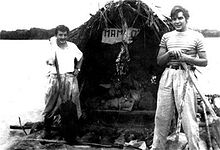
Guevara (Right) Alberto Granado (left)


Guevara joined military training in the movement. He learned guerilla warfare tactics. He walked through mountains, and rivers. He practiced ambush, and retreat war tactics. The instructor Alberto Bayo praised Guevara as the best student in the training. Guevara lived with poor farmers of Sierra Maestra mountains. Guevara built grenade factories, ovens to bake bread, and organized schools. He also founded health clinics, workshops, and newspaper. He also set up the clandestine radio station Radio Rebelde ( Radio Rebel) in February 1958.

Batista’s army put to death rebel prisoners and killed civilians. In 1958, Guevara took important role in Battle of Las Mercedes. His sparkling tactics amazed Major Larry Bookman, the US Marine Corps. Walking on foot in Havana Guevara continued his guerrilla. He often had no food for some days. He went at night.
Route of che trip

He took his victory in Las Villas province. Then, he sent suicide troops in capital city of Santa Clara. He grabbed the city and became the success of the revolution. Six weeks battle in Santa Clara showed the genius of Che. Radio Rebelde broadcasted that Guevara had seized Santa Clara on New Year’s Eve 1958. Fulgencio Batista flew to Havana for the Dominican Republic.

In January 1959, Guevara wrote his book Guerrilla Warfare when he was at villa Tarara. He earned Cuban Citizen in February. He also got divorced with Hilda Gaeda on June 2, 1959. He then Married Aleida March. He had five children from his two wives.


Fidel Castro became the new leader in Cuba. He took Guevara as the commander of the La Cabaña Fortress prison, from January 2 to June 12, 1959. On January 27, 1959 Guevara spoke the social justice and land reform. On May 17, 1959, the Agrarian Reform Law brought by Guevara was effective. Fidel Castro established National Institute of Agrarian Reform ( INRA). Guevara led the institution.

Castro delegated Guevara for a three- month visit of Bandung Pact countries. He went to Sudan, Morocco, Egypt, Syria, Pakistan, Indonesia, India, Sri Lanka, Burma, Thailand, Japan, Yugoslavia, Greece, Singapore and Hongkong. He visited Hiroshima where US dropped Atomic Bomb.

Guevara commanded over 100,000 volunteers as “literacy brigades”. The volunteers went to countryside. They built schools, taught peasants to read and write, and supplied new teachers. The campaign was called the Cuban Literacy Campaign. Guevara made success in this project. The rate of literacy reached 96 %. He also created links to higher education.


Castro pointed Guevara as the Finance Minister and the president of National Bank. He also was the Minister of Industries. His signature on Cuban currency caused many protests from financial segments. He signed on the bills “Che” instead of his full name. He broke the belief that money was sacred. His signature was a symbol of art. Guevara’s economic program failed. Dropped productivity occurred during this program. His program “moral incentive” raised many critics. The director of Radio Marti, Ernesto Betancourt said that Guevara was ignorant of the most basic economic principles.

After Santa Clara Battle
Guevara drew from public two weeks after his speaking in Algiers. His vanish was mystery for Cubans. His resignation was due to his failure in the industrialization campaign. He discarded his Cuban citizenship. On October 3, 1965, Castro announced publicly a Guevara’s letter with no date few months earlier. Guevara said that he supported the Cuban Revolution but he committed to leave Cuba to fight for revolutionary.


Guevara joined National Liberation Army (Bolivia). Guevara met Tamara Bunke in Germany ( Tania) when he was the ministers of Castro’s Government. She was an interpreter that joined him in Bolivia. Guevara and Tania ended their life in La Higuera , Bolivia on October 9, 1967.


Short biography of Albert Einstein.

Einstein is a scientist. He is the inventor of theory of relativity. His full name is Albert Einstein. He was born on March 14, 1879 in Ulm, Württemberg, Germany. His parents were Jewish. They were Hermann and Pauline Einstein. Einstein went to Luitpold Elementary school. He was interested to study math and science better than grammar. He followed his family to Italy. Then, he resumed his study at Swiss school in Aarau. He enrolled at Federal Polytechnic School in Zurich in 1896. He got diploma degree in teaching physics and math.
Albert Einstein
Albert Einstein

Einstein worked at the patent office in Switzerland. During his work in his office, he made much amazing project. He invented some scientific works in 1905. He found the theory of relativity in physics. He made a formula E= m.c2. E was Energy, m was mass, and c was the speed of light in vacuum ( ca.300,000 km/s).

Einstein became Privatdozent in Berne in 1908. He was also the professor of extraordinary in Zurich in 1909. He earned professor of theoretical Physics in Prague in 1911. He was the director of Kaiser Wilhelm Physical Institute and professor at the University of Berlin in 1914. He got a German citizen in the same year. He went to U.S. and settled in Princeton, New Jersey in 1940. He became a professor of theoretical physics there.

Works and Achievement

Einstein had some achievements and works. He wrote his projects. The most popular is about the theory of relativity. Einstein made experiments for his theory. His proven theory in 1919 made him a world famous scientist. Einstein went around the world for presenting his theory.

Here are some of his works.

- Theory of Relativity in 1905.

- Relativity in 1920 and 1950.

- General theory of Relativity in 1916.

- Investigations on theory of Brownian Movement in 1926.

- The Evolution of Physics in 1938.

He also wrote non science books.

- Zionism in 1930.

- Why war? in 1933.

- My philosophy in 1934.

- Out of my later years 1950.

He achieved successful career in science.

- Privatdozent in Berne in 1908.

- Professor Extraordinary in Zurich in 1909.

- Professor of Theoretical Physics in Prague in 1911.

- Director of the Kaiser Wilhelm Physical Institute and Professor at the University of Berlin in 1914.

- Professor of Theoretical Physics in Princeton.

He passed away on April 18, 1955 in Princeton, New Jersey. He had a daughter and two sons from his first wife Mileva Maric. His second wife was Elsa Lowenthal. 

Wednesday, 4 January 2012

Bodhidharma life history

Bodhidharma is credited with bringing Zen Buddhism to China and he is the First Patriarch of Chinese Zen Lineage. He was born on Oct. 5th. (Chinese Lunar Calendar) in Southern India, and was the third son of an Indian King; the royal family belonged to the Bhramin caste. Bodhidharma's Buddhist Master, Prajnatara, was the 27th Patriarch of Indian Buddhism, taught Bodhidharma for many years, gave him Mind Transmission, made him the 28th Patriarch, and gave him the name Bodhidharma. Following the instruction of his Master to transmit Dharma to China, Bodhidharma traveled east to Southern China in 526 A.D. When he arrived in Kwang Chou, he was ceremoniously welcomed and greatly honored by the local military official named Shao Yang. The same year, he was invited to the Capitol, Nanjing, to meet Emperor Wu Di of the Liang dynasty. Because the communication between the Emperor and Bodhidharma was mutually unsatisfactory, Bodhidharma left the palace, crossed the Yangtzu River, and continued north until he arrived at the Shao Lin Temple in Ho Nan Province. It was here that Bodhidharma became famous for meditating 9 years facing a wall.
After he gave his disciple, Hui K'o, the Robe, Begging Bowl, Lankavatara Sutra, and Mind Transmission, Bodhidharma went to Chen Sung (One Thousand Saints) Temple to propagate the Dharma. He passed into Nirvana in 536 A.D., was buried in Shon Er Shan (Bear Ear Mountain) in Ho Nan, and a stupa was built for him in Pao Lin Temple. Later, the Tang dynasty Emperor, Dai Dzong, bestowed on Bodhidharma the name Yuen Che Grand Zen Master, and renamed his stupa as Kong Kwan (Empty Visualization).


Bodhidharma's Teachings:
Bodhidharma instructed his disciples that the Lankavatara Sutra be used to seal the mind. The method of cultivating practice transmitted by Bodhidharma pointed out that we should pay attention closely to this important sutra. His major teaching is there are two paths to enter Dharma Gate: Study and Practice. Study: through the study of Buddhist sutras and scriptures, you will understand Buddha Nature. Your Buddha Nature doesn't manifest because it is clouded by defilements, such as: greed, attachment, passion, aggression and ignorance. Practice: when you follow Buddhist principles in your daily life, you discover that your Buddha Nature is equal to the Buddha's.

  1. Bao Yen Hsin: The willingness to accept, without complaining, suffering and unhappiness because you understand it is your own karma.
  2. Sui Yen Hsin: Understanding that all situations are the consequences of karmic causes, and therefore, you maintain equanimity in all circumstances, both negative and positive.
  3. Tsung Fa Hsin: Realizing through practice the essence of your Buddha Nature, which is equanimity.


Bodhidharma brought Zen from India to China and lived in the Shaolin Temple that ironically became famous for Kung Fu hundreds of years later.  He was an Indian person so his facial features were quite dramatic, to the Chinese.  Accordingly, he is heavily stylized when depicted.

The statue above is a very standard depiction, while the round, red ball thing on the top right is a unique, Japanese version.  In Japan temples sell wooden versions in this style without eye pupils.  You take it home and paint one pupil in before starting a big task, such as studying for a test.  when the task is successfully completed, you paint the seconds pupil in and return him to the temple.

This is why you are sometimes greeted by hundreds of Daruma Dolls when entering the external shrine of a Japanese temple.  You will also see Daruma when Japanese win and election.  They usually paint the second pupil in at the press conference when they announce their victory.


Bodhidharma's years of meditation
in the cave are said to have
left his shadow on this rock,
removed from the cave and
 on display in the Shaolin Temple.
Daruma meets the King
When he arrived in China, Daruma had to meet the King.  The King was well known for spending on Buddhist temples, hospitals, schools and other public works.  He asked Daruma "What merit have I accumulated for all my works?"

Daruma replied "None."

"Ok then, what is the meaning of the Dharma (Buddhist teachings)?"
"Only emptiness, nothing sacred."
"Who stands before me?"
"I don't know."

This became a famous Zen dialogue with many interpretations.  One of the best is: Good works make karma for your wealth, but wisdom is needed if you to are escape Samsara .
In any case the king must have been a great guy, because almost any other king in history would have cut Daruma's head off for being cheeky.


Daruma invigorates the Shaolin Temple
Next Daruma travelled north, eventually arriving at the Shaolin Temple.  A popular legend claims he crossed the Yangtze River on a reed to get there.  This is often depicted in images of him including the Ming Dynasty (1368-1644) figurine on the left.
At Shaolin he spent nine years meditating while facing a wall.  He took no disciples until one monk cut off his arm to prove his sincerity in relieving his suffering.  This disciple was Master Hui K’o, who became Daruma's successor.
There's an interesting legend that 3 years after Daruma died he met a Chinese official in central Asia.  According to the legend, he told the official he was retuning to India and carrying a single shoe.  The resulting controversy caused the monks to open Daruma's grave where only a single shoe was found.  Whatever the actual facts are, this led to yet another popular depiction of Daruma as travelling with a single show in toe, as in the Qing Dynasty figure on the right.

Sunday, 25 December 2011

Life history of Adolf Hitler


Adolf Hitler

(1889-1945)


Adolf Hitler (1889-1945) was the founder and leader of the Nazi Party and the most influential voice in the organization, implementation and execution of the Holocaust, the systematic extermination and ethnic cleansing of six million European Jews and millions of other non-aryans.
Hitler was the Head of State, Supreme Commander of the Armed Forces and guiding spirit, or fuhrer, of Germany's Third Reich from 1933 to 1945.

Early Years

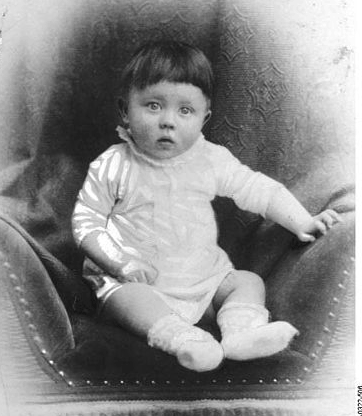
Hitler as a baby
Born in Braunau am Inn, Austria, on April 20, 1889, Hitler was the son of a fifty-two-year-old Austrian customs official, Alois Schickelgruber Hitler, and his third wife, a young peasant girl, Klara Poelzl, both from the backwoods of lower Austria. The young Hitler was a resentful, discontented child. Moody, lazy, of unstable temperament, he was deeply hostile towards his strict, authoritarian father and strongly attached to his indulgent, hard-working mother, whose death from cancer in December 1908 was a shattering blow to the adolescent Hitler.
After spending four years in the Realschule in Linz, he left school at the age of sixteen with dreams of becoming a painter. In October 1907, the provincial, middle-class boy left home for Vienna, where he was to remain until 1913 leading a bohemian, vagabond existence. Embittered at his rejection by the Viennese Academy of Fine Arts, he was to spend "five years of misery and woe" in Vienna as he later recalled, adopting a view of life which changed very little in the ensuing years, shaped as it was by a pathological hatred of Jews and Marxists, liberalism and the cosmopolitan Habsburg monarchy.
Existing from hand to mouth on occasional odd jobs and the hawking of sketches in low taverns, the young Hitler compensated for the frustrations of a lonely bachelor's life in miserable male hostels by political harangues in cheap cafes to anyone who would listen and indulging in grandiose dreams of a Greater Germany.
In Vienna he acquired his first education in politics by studying the demagogic techniques of the popular Christian-social Mayor, Karl Lueger, and picked up the stereotyped, obsessive anti-Semitism with its brutal, violent sexual connotations and concern with the "purity of blood" that remained with him to the end of his career. From crackpot racial theorists like the defrocked monk, Lanz von Liebenfels, and the Austrian Pan-German leader, Georg von Schoenerer, the young Hitler learned to discern in the "Eternal Jew" the symbol and cause of all chaos, corruption and destruction in culture, politics and the economy. The press, prostitution, syphilis, capitalism, Marxism, democracy and pacifism--all were so many means which "the Jew" exploited in his conspiracy to undermine the German nation and the purity of the creative Aryan race.

World War I

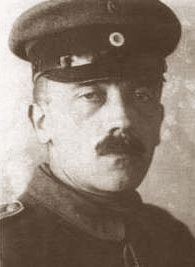
Hitler as a soldier during World War 1 (circa 1915)
In May 1913 Hitler left Vienna for Munich and, when war broke out in August 1914, he joined the Sixteenth Bavarian Infantry Regiment, serving as a despatch runner. Hitler proved an able, courageous soldier, receiving the Iron Cross (First Class) for bravery, but did not rise above the rank of Lance Corporal. Twice wounded, he was badly gassed four weeks before the end of the war and spent three months recuperating in a hospital in Pomerania. Temporarily blinded and driven to impotent rage by the abortive November 1918 revolution in Germany as well as the military defeat, Hitler, once restored, was convinced that fate had chosen him to rescue a humiliated nation from the shackles of the Versailles Treaty, from Bolsheviks and Jews.
Assigned by the Reichswehr in the summer of 1919 to "educational" duties which consisted largely of spying on political parties in the overheated atmosphere of post-revolutionary Munich, Hitler was sent to investigate a small nationalistic group of idealists, the German Workers' Party. On 16 September 1919 he entered the Party (which had approximately forty members), soon changed its name to the National Socialist German Workers' Party (NSDAP) and had imposed himself as its Chairman by July 1921.

Hitler Becomes a Leader

Hitler discovered a powerful talent for oratory as well as giving the new Party its symbol — the swastika — and its greeting "Heil!." His hoarse, grating voice, for all the bombastic, humourless, histrionic content of his speeches, dominated audiences by dint of his tone of impassioned conviction and gift for self-dramatization. By November 1921 Hitler was recognized as Fuhrer of a movement which had 3,000 members, and boosted his personal power by organizing strong- arm squads to keep order at his meetings and break up those of his opponents. Out of these squads grew the storm troopers (SA) organized by Captain Ernst Röhm and Hitler's black-shirted personal bodyguard, the Schutzstaffel (SS).
Hitler focused his propaganda against the Versailles Treaty, the "November criminals," the Marxists and the visible, internal enemy No. 1, the "Jew," who was responsible for all Germany's domestic problems. In the twenty-five-point programme of the NSDAP announced on 24 February 1920, the exclusion of the Jews from the Volk community, the myth of Aryan race supremacy and extreme nationalism were combined with "socialistic" ideas of profit-sharing and nationalization inspired by ideologues like Gottfried Feder. Hitler's first written utterance on political questions dating from this period emphasized that what he called "the anti-Semitism of reason" must lead "to the systematic combating and elimination of Jewish privileges. Its ultimate goal must implacably be the total removal of the Jews."
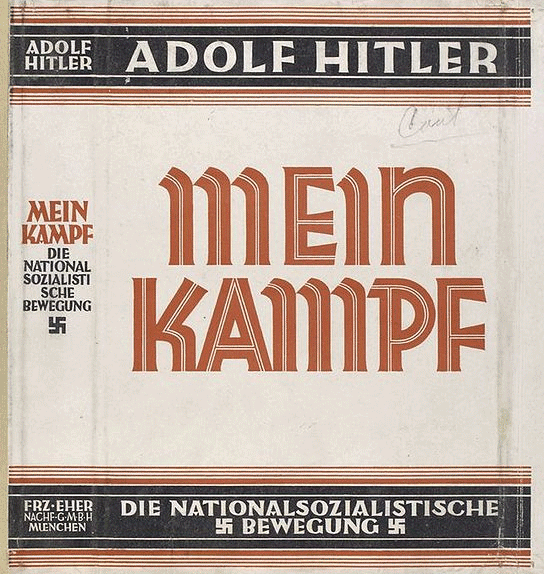
Cover of Hitler's treatise, Mein Kampf
By November 1923 Hitler was convinced that the Weimar Republic was on the verge of collapse and, together with General Ludendorff and local nationalist groups, sought to overthrow the Bavarian government in Munich. Bursting into a beer-hall in Munich and firing his pistol into the ceiling, he shouted out that he was heading a new provisional government which would carry through a revolution against "Red Berlin." Hitler and Ludendorff then marched through Munich at the head of 3,000 men, only to be met by police fire which left sixteen dead and brought the attempted putsch to an ignominious end. Hitler was arrested and tried on 26 February 1924, succeeding in turning the tables on his accusers with a confident, propagandist speech which ended with the prophecy: "Pronounce us guilty a thousand times over: the goddess of the eternal court of history will smile and tear to pieces the State Prosecutor's submission and the court's verdict for she acquits us." Sentenced to five years' imprisonment in Landsberg fortress, Hitler was released after only nine months during which he dictated Mein Kampf (My Struggle) to his loyal follower, Rudolf Hess. Subsequently the "bible" of the Nazi Party, this crude, half-baked hotchpotch of primitive Social Darwinism, racial myth, anti-Semitism and lebensraum fantasy had sold over five million copies by 1939 and been translated into eleven languages.
The failure of the Beer-Hall putsch and his period of imprisonment transformed Hitler from an incompetent adventurer into a shrewd political tactician, who henceforth decided that he would never again confront the gun barrels of army and police until they were under his command. He concluded that the road to power lay not through force alone but through legal subversion of the Weimar Constitution, the building of a mass movement and the combination of parliamentary strength with extra-parliamentary street terror and intimidation. Helped by Goering and Goebbels he began to reassemble his followers and rebuild the movement which had disintegrated in his absence.

Rise of the Nazi Party

In January 1925 the ban on the Nazi Party was removed and Hitler regained permission to speak in public. Outmaneuvering the "socialist" North German wing of the Party under Gregor Strasser, Hitler re-established himself in 1926 as the ultimate arbiter to whom all factions appealed in an ideologically and socially heterogeneous movement. Avoiding rigid, programmatic definitions of National Socialism which would have undermined the charismatic nature of his legitimacy and his claim to absolute leadership, Hitler succeeded in extending his appeal beyond Bavaria and attracting both Right and Left to his movement.
Though the Nazi Party won only twelve seats in the 1928 elections, the onset of the Great Depression with its devastating effects on the middle classes helped Hitler to win over all those strata in German society who felt their economic existence was threatened. In addition to peasants, artisans, craftsmen, traders, small businessmen, ex-officers, students and declasse intellectuals, the Nazis in 1929 began to win over the big industrialists, nationalist conservatives and army circles. With the backing of the press tycoon, Alfred Hugenberg, Hitler received a tremendous nationwide exposure just as the effects of the world economic crisis hit Germany, producing mass unemployment, social dissolution, fear and indignation. With demagogic virtuosity, Hitler played on national resentments, feelings of revolt and the desire for strong leadership using all the most modern techniques of mass persuasion to present himself as Germany's redeemer and messianic saviour.
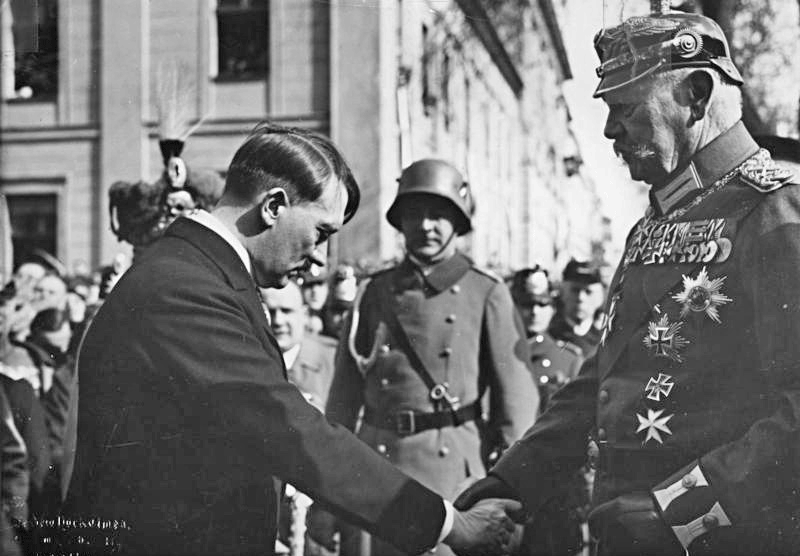
Hitler and President von Hindenburg (1933)
In the 1930 elections the Nazi vote jumped dramatically from 810,000 to 6,409,000 (18.3 percent of the total vote) and they received 107 seats in the Reichstag. Prompted by Hjalmar Schacht and Fritz Thyssen, the great industrial magnates began to contribute liberally to the coffers of the NSDAP, reassured by Hitler's performance before the Industrial Club in Dusseldorf on 27 January 1932 that they had nothing to fear from the radicals in the Party. The following month Hitler officially acquired German citizenship and decided to run for the Presidency, receiving 13,418,011 votes in the run-off elections of 10 April 1931 as against 19,359,650 votes for the victorious von Hindenburg , but four times the vote for the communist candidate, Ernst Thaelmann. In the Reichstag elections of July 1932 the Nazis emerged as the largest political party in Germany, obtaining nearly fourteen million votes (37.3 per cent) and 230 seats. Although the NSDAP fell back in November 1932 to eleven million votes (196 seats), Hitler was helped to power by a camarilla of conservative politicians led by Franz von Papen, who persuaded the reluctant von Hindenburg to nominate "the Bohemian corporal" as Reich Chancellor on 30 January 1933.
Once in the saddle, Hitler moved with great speed to outmanoeuvre his rivals, virtually ousting the conservatives from any real participation in government by July 1933, abolishing the free trade unions, eliminating the communists, Social Democrats and Jews from any role in political life and sweeping opponents into concentration camps. The Reichstag fire of 27 February 1933 had provided him with the perfect pretext to begin consolidating the foundations of a totalitarian one-party State, and special "enabling laws" were ramrodded through the Reichstag to legalize the regime's intimidatory tactics.
With support from the nationalists, Hitler gained a majority at the last "democratic" elections held in Germany on 5 March 1933 and with cynical skill he used the whole gamut of persuasion, propaganda, terror and intimidation to secure his hold on power. The seductive notions of "National Awakening" and a "Legal Revolution" helped paralyse potential opposition and disguise the reality of autocratic power behind a facade of traditional institutions.

Hitler As Fuhrer

Hitler after an SS rally in Berlin
The destruction of the radical SA leadership under Ernst Rohm in the Blood Purge of June 1934 confirmed Hitler as undisputed dictator of the Third Reich and by the beginning of August, when he united the positions of Fuhrer and Chancellor on the death of von Hindenburg, he had all the powers of State in his hands. Avoiding any institutionalization of authority and status which could challenge his own undisputed position as supreme arbiter, Hitler allowed subordinates like Himmler, Goering and Goebbels to mark out their own domains of arbitrary power while multiplying and duplicating offices to a bewildering degree.
During the next four years Hitler enjoyed a dazzling string of domestic and international successes, outwitting rival political leaders abroad just as he had defeated his opposition at home. In 1935 he abandoned the Versailles Treaty and began to build up the army by conscripting five times its permitted number. He persuaded Great Britain to allow an increase in the naval building programme and in March 1936 he occupied the demilitarized Rhineland without meeting opposition. He began building up the Luftwaffe and supplied military aid to Francoist forces in Spain, which brought about the Spanish fascist victory in 1939.
The German rearmament programme led to full employment and an unrestrained expansion of production, which reinforced by his foreign policy successes--the Rome-Berlin pact of 1936, the Anschluss with Austria and the "liberation" of the Sudeten Germans in 1938 — brought Hitler to the zenith of his popularity. In February 1938 he dismissed sixteen senior generals and took personal command of the armed forces, thus ensuring that he would be able to implement his aggressive designs.
Hitler's saber-rattling tactics bludgeoned the British and French into the humiliating Munich agreement of 1938 and the eventual dismantlement of the Czechoslovakian State in March 1939. The concentration camps, the Nuremberg racial laws against the Jews, the persecution of the churches and political dissidents were forgotten by many Germans in the euphoria of Hitler's territorial expansion and bloodless victories. The next designated target for Hitler's ambitions was Poland (her independence guaranteed by Britain and France) and, to avoid a two-front war, the Nazi dictator signed a pact of friendship and non-aggression with Soviet Russia.

World War II

On September 1, 1939, German armed forces invaded Poland and henceforth Hitler's main energies were devoted to the conduct of a war he had unleashed to dominate Europe and secure Germany's "living space."
The first phase of World War II was dominated by German Blitzkrieg tactics: sudden shock attacks against airfields, communications, military installations, using fast mobile armor and infantry to follow up on the first wave of bomber and fighter aircraft. Poland was overrun in less than one month, Denmark and Norway in two months, Holland, Belgium, Luxemburg and France in six weeks. After the fall of France in June 1940 only Great Britain stood firm.
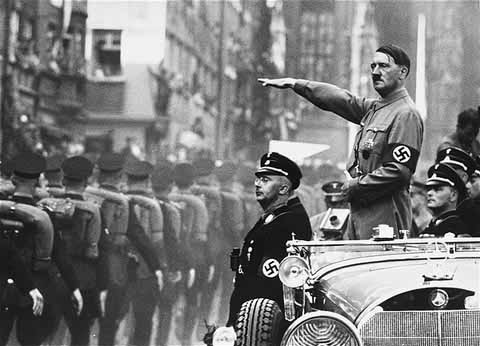
Hitler showing the Nazi salute
The Battle of Britain, in which the Royal Air Force prevented the Luftwaffe from securing aerial control over the English Channel, was Hitler's first setback, causing the planned invasion of the British Isles to be postponed. Hitler turned to the Balkans and North Africa where his Italian allies had suffered defeats, his armies rapidly overrunning Greece, Yugoslavia, the island of Crete and driving the British from Cyrenaica.
The crucial decision of his career, the invasion of Soviet Russia on June 22, 1941, was rationalized by the idea that its destruction would prevent Great Britain from continuing the war with any prospect of success. He was convinced that once he kicked the door in, as he told Jodl (q.v.), "the whole rotten edifice [of communist rule] will come tumbling down" and the campaign would be over in six weeks. The war against Russia was to be an anti-Bolshivek crusade, a war of annihilation in which the fate of European Jewry would finally be sealed. At the end of January 1939 Hitler had prophesied that "if the international financial Jewry within and outside Europe should succeed once more in dragging the nations into a war, the result will be, not the Bolshevization of the world and thereby the victory of Jewry, but the annihilation of the Jewish race in Europe."
As the war widened — the United States by the end of 1941 had entered the struggle against the Axis powers — Hitler identified the totality of Germany's enemies with "international Jewry," who supposedly stood behind the British-American-Soviet alliance. The policy of forced emigration had manifestly failed to remove the Jews from Germany's expanded lebensraum, increasing their numbers under German rule as the Wehrmacht moved East.
The widening of the conflict into a world war by the end of 1941, the refusal of the British to accept Germany's right to continental European hegemony (which Hitler attributed to "Jewish" influence) and to agree to his "peace" terms, the racial-ideological nature of the assault on Soviet Russia, finally drove Hitler to implement the "Final Solution of the Jewish Question" which had been under consideration since 1939. The measures already taken in those regions of Poland annexed to the Reich against Jews (and Poles) indicated the genocidal implications of Nazi-style "Germanization" policies. The invasion of Soviet Russia was to set the seal on Hitler's notion of territorial conquest in the East, which was inextricably linked with annihilating the 'biological roots of Bolshevism' and hence with the liquidation of all Jews under German rule.
At first the German armies carried all before them, overrunning vast territories, overwhelming the Red Army, encircling Leningrad and reaching within striking distance of Moscow. Within a few months of the invasion Hitler's armies had extended the Third Reich from the Atlantic to the Caucasus, from the Baltic to the Black Sea. But the Soviet Union did not collapse as expected and Hitler, instead of concentrating his attack on Moscow, ordered a pincer movement around Kiev to seize the Ukraine, increasingly procrastinating and changing his mind about objectives. Underestimating the depth of military reserves on which the Russians could call, the caliber of their generals and the resilient, fighting spirit of the Russian people (whom he dismissed as inferior peasants), Hitler prematurely proclaimed in October 1941 that the Soviet Union had been "struck down and would never rise again." In reality he had overlooked the pitiless Russian winter to which his own troops were now condemned and which forced the Wehrmacht to abandon the highly mobile warfare which had previously brought such spectacular successes.
The disaster before Moscow in December 1941 led him to dismiss his Commander-in-Chief von Brauchitsch, and many other key commanders who sought permission for tactical withdrawals, including Guderian, Bock, Hoepner, von Rundstedt and Leeb, found themselves cashiered. Hitler now assumed personal control of all military operations, refusing to listen to advice, disregarding unpalatable facts and rejecting everything that did not fit into his preconceived picture of reality. His neglect of the Mediterranean theatre and the Middle East, the failure of the Italians, the entry of the United States into the war, and above all the stubborn determination of the Russians, pushed Hitler on to the defensive. From the winter of 1941 the writing was on the wall but Hitler refused to countenance military defeat, believing that implacable will and the rigid refusal to abandon positions could make up for inferior resources and the lack of a sound overall strategy.
Convinced that his own General Staff was weak and indecisive, if not openly treacherous, Hitler became more prone to outbursts of blind, hysterical fury towards his generals, when he did not retreat into bouts of misanthropic brooding. His health, too, deteriorated under the impact of the drugs prescribed by his quack physician, Dr. Theodor Morell. Hitler's personal decline, symbolized by his increasingly rare public appearances and his self-enforced isolation in the "Wolf's Lair," his headquarters buried deep in the East Prussian forests, coincided with the visible signs of the coming German defeat which became apparent in mid-1942.

Allied Victory and Hitler's Death

Rommel's defeat at El Alamein and the subsequent loss of North Africa to the Anglo-American forces were overshadowed by the disaster at Stalingrad where General von Paulus's Sixth Army was cut off and surrendered to the Russians in January 1943. In July 1943 the Allies captured Sicily and Mussolini's regime collapsed in Italy. In September the Italians signed an armistice and the Allies landed at Salerno, reaching Naples on 1 October and taking Rome on June 4, 1944. The Allied invasion of Normandy followed on June 6, 1944 and soon a million Allied troops were driving the German armies eastwards, while from the opposite direction the Soviet forces advanced relentlessly on the Reich. The total mobilization of the German war economy under Albert Speer and the energetic propaganda efforts of Joseph Goebbels to rouse the fighting spirit of the German people were impotent to change the fact that the Third Reich lacked the resources equal to a struggle against the world alliance which Hitler himself had provoked.
Front Page of US Army newspaper announcing Hitlers death (1945)
Allied bombing began to have a telling effect on German industrial production and to undermine the morale of the population. The generals, frustrated by Hitler's total refusal to trust them in the field and recognizing the inevitability of defeat, planned, together with the small anti-Nazi Resistance inside the Reich, to assassinate the Fuhrer on 20 July 1944, hoping to pave the way for a negotiated peace with the Allies that would save Germany from destruction. The plot failed and Hitler took implacable vengeance on the conspirators, watching with satisfaction a film of the grisly executions carried out on his orders.
As disaster came closer, Hitler buried himself in the unreal world of the Fuhrerbunker in Berlin, clutching at fantastic hopes that his "secret weapons," the V-1 and V-2 rockets, would yet turn the tide of war. He gestured wildly over maps, planned and directed attacks with non-existent armies and indulged in endless, night-long monologues which reflected his growing senility, misanthropy and contempt for the "cowardly failure" of the German people.
As the Red Army approached Berlin and the Anglo-Americans reached the Elbe, on 19 March 1945 Hitler ordered the destruction of what remained of German industry, communications and transport systems. He was resolved that, if he did not survive, Germany too should be destroyed. The same ruthless nihilism and passion for destruction which had led to the extermination of six million Jews in death camps, to the biological "cleansing" of the sub-human Slavs and other subject peoples in the New Order, was finally turned on his own people.
On April 29, 1945, he married his mistress Eva Braun and dictated his final political testament, concluding with the same monotonous, obsessive fixation that had guided his career from the beginning: "Above all I charge the leaders of the nation and those under them to scrupulous observance of the laws of race and to merciless opposition to the universal poisoner of all peoples, international Jewry."
The following day Hitler committed suicide, shooting himself through the mouth with a pistol. His body was carried into the garden of the Reich Chancellery by aides, covered with petrol and burned along with that of Eva Braun. This final, macabre act of self-destruction appropriately symbolized the career of a political leader whose main legacy to Europe was the ruin of its civilization and the senseless sacrifice of human life for the sake of power and his own commitment to the bestial nonsense of National Socialist race mythology. With his death nothing was left of the "Greater Germanic Reich," of the tyrannical power structure and ideological system which had devastated Europe during the twelve years of his totalitarian rule.

Joseph Stalin biography

Quick Facts

  • NAME: Joseph Stalin
  • OCCUPATION: Dictator
  • BIRTH DATE: December 18, 1878
  • DEATH DATE: March 05, 1953
  • PLACE OF BIRTH: Gori, Tiflis Governorate
more about Joseph

Best Known For

Joseph Stalin, the first General Secretary of the Communist Party, took over after Vladimir Lenin's death and became the leader of the Soviet Union.

Joseph Stalin (b. December 18, 1878 in the Russian Empire) served as the first General Secretary of the Communist Party of the Soviet Union's Central Committee from 1922 until his death in 1953. Stalin assumed the leading role in Soviet politics after Vladimir Lenin's death in 1924, and gradually marginalized his opponents until he had become the unchallenged leader of the Soviet Union.

Profile

(born Dec. 18, 1879, Gori, Georgia, Russian Empire—died March 5, 1953, Moscow, Russia, U.S.S.R.) Soviet politician and dictator. The son of a cobbler, he studied at a seminary but was expelled for revolutionary activity in 1899. He joined an underground revolutionary group and sided with the Bolshevik faction of the Russian Social-Democratic Workers' Party in 1903. A disciple of Vladimir Lenin, he served in minor party posts and was appointed to the first Bolshevik Central Committee (1912). He remained active behind the scenes and in exile (1913–17) until the Russian Revolution of 1917 brought the Bolsheviks to power. Having adopted the name Stalin (from Russian stal, “steel”), he served as commissar for nationalities and for state control in the Bolshevik government (1917–23). He was a member of the Politburo, and in 1922 he became secretary-general of the party's Central Committee. After Lenin's death (1924), Stalin overcame his rivals, including Leon Trotsky, Grigory Zinovyev, Lev Kamenev, Nikolay Bukharin, and Aleksey Rykov, and took control of Soviet politics. In 1928 he inaugurated the Five-Year Plans that radically altered Soviet economic and social structures and resulted in the deaths of many millions. In the 1930s he contrived to eliminate threats to his power through the purge trials and through widespread secret executions and persecution. In World War II he signed the German-Soviet Nonaggression Pact (1939), attacked Finland ( Russo-Finnish War), and annexed parts of eastern Europe to strengthen his western frontiers. When Germany invaded Russia (1941), Stalin took control of military operations. He allied Russia with Britain and the U.S.; at the Tehrn, Yalta, and Potsdam conferences, he demonstrated his negotiating skill. After the war he consolidated Soviet power in eastern Europe and built up the Soviet Union as a world military power. He continued his repressive political measures to control internal dissent; increasingly paranoid, he was preparing to mount another purge after the so-called Doctors' Plot when he died. Noted for bringing the Soviet Union into world prominence, at terrible cost to his own people, he left a legacy of repression and fear as well as industrial and military power. In 1956 Stalin and his personality cult were denounced by Nikita Khrushchev.

Jawaharlal Nehru Biography

Born: November 14, 1889
Died: May 27, 1964
Achievements: Took active part in Non-Cooperation Movement; elected President of the Allahabad Municipal Corporation in 1924, and served for two years as the city's chief executive; Presided over Congress' annual session in Lahore in 1929 and passed a resolution demanding India's independence; elected as Congress President in 1936, 1937, and 1946; became first Prime Minister of independent India; was one of the main architects of Non Aligned Movement.

Jawaharlal Nehru, also known as Pandit Jawaharlal Nehru, was one of the foremost leaders of Indian freedom struggle. He was the favourite disciple of Mahatma Gandhi and later on went on to become the first Prime Minister of India. Jawahar Lal Nehru is widely regarded as the architect of modern India. He was very fond of children and children used to affectionately call him Chacha Nehru.

Jawahar Lal Nehru was born on November 14, 1889. His father Motilal Nehru was a famous Allahabad based barrister. Jawaharlal Nehru's mother's name was Swaroop Rani. Jawaharlal Nehru was the only son of Motilal Nehru. Motilal Nehru has three daughters apart from Jawaharlal Nehru. Nehrus were Saraswat Brahmin of Kashmiri lineage.

Jawaharlal Nehru received education in some of the finest schools and universities of the world. He did his schooling from Harrow and completed his Law degree from Trinity College, Cambridge. The seven years he spent in England widened his horizons and he acquired a rational and skeptical outlook and sampled Fabian socialism and Irish nationalism, which added to his own patriotic dedication.

Jawaharlal Nehru returned to India in 1912 and started legal practice. He married Kamala Nehru in 1916. Jawahar Lal Nehru joined Home Rule League in 1917. His real initiation into politics came two years later when he came in contact with Mahatma Gandhi in 1919. At that time Mahatma Gandhi had launched a campaign against Rowlatt Act. Nehru was instantly attracted to Gandhi's commitment for active but peaceful, civil disobedience. Gandhi himself saw promise and India's future in the young Jawaharlal Nehru.

Nehru family changed its family according to Mahatma Gandhi's teachings. Jawaharlal and Motilal Nehru abandoned western clothes and tastes for expensive possessions and pastimes. They now wore a Khadi Kurta and Gandhi cap. Jawaharlal Nehru took active part in the Non- Cooperation Movement 1920-1922) and was arrested for the first time during the movement. He was released after few months.

Jawaharlal Nehru was elected President of the Allahabad Municipal Corporation in 1924, and served for two years as the city's chief executive. This proved to be a valuable administrative experience for stood him in good stead later on when he became the prime minister of the country. He used his tenure to expand public education, health care and sanitation. He resigned in 1926 citing lack of cooperation from civil servants and obstruction from British authorities.

From 1926 to 1928, Jawaharlal served as the General Secretary of the All India Congress Committee. In 1928-29, the Congress's annual session under President Motilal Nehru was held. During that session Jawaharlal Nehru and Subhas Chandra Bose backed a call for full political independence, while Motilal Nehru and others wanted dominion status within the British Empire. To resolve the point, Gandhi said that the British would be given two years to grant India dominion status. If they did not, the Congress would launch a national struggle for full, political independence. Nehru and Bose reduced the time of opportunity to one year. The British did not respond.

In December 1929, Congress's annual session was held in Lahore and Jawaharlal Nehru was elected as the President of the Congress Party. During that sessions a resolution demanding India's independence was passed and on January 26, 1930 in Lahore, Jawaharlal Nehru unfurled free India's flag. Gandhiji gave a call for Civil Disobedience Movement in 1930. The movement was a great success and forced British Government to acknowledge the need for major political reforms.

When the British promulgated the Government of India Act 1935, the Congress Party decided to contest elections. Nehru stayed out of the elections, but campaigned vigorously nationwide for the party. The Congress formed governments in almost every province, and won the largest number of seats in the Central Assembly. Nehru was elected to the Congress presidency in 1936, 1937, and 1946, and came to occupy a position in the nationalist movement second only to that of Gandhi. Jawaharlal Nehru was arrested in 1942 during Quit India Movement. Released in 1945, he took a leading part in the negotiations that culminated in the emergence of the dominions of India and Pakistan in August 1947.

In 1947, he becamethe first Prime Minister of independent India. He effectively coped with the formidable challenges of those times: the disorders and mass exodus of minorities across the new border with Pakistan, the integration of 500-odd princely states into the Indian Union, the framing of a new constitution, and the establishment of the political and administrative infrastructure for a parliamentary democracy.

Jawaharlal Nehru played a key role in building modern India. He set up a Planning Commission, encouraged development of science and technology, and launched three successive five-year plans. His policies led to a sizable growth in agricultural and industrial production. Nehru also played a major role in developing independent India's foreign policy. He called for liquidation of colonialism in Asia and Africa and along with Tito and Nasser, was one of the chief architects of the nonaligned movement. He played a constructive, mediatory role in bringing the Korean War to an end and in resolving other international crises, such as those over the Suez Canal and the Congo, offering India's services for conciliation and international policing. He contributed behind the scenes toward the solution of several other explosive issues, such as those of West Berlin, Austria, and Laos.

But Jawahar Lal Nehru couldn't improve India's relations with Pakistan and China. The Kashmir issue proved a stumbling block in reaching an accord with Pakistan, and the border dispute prevented a resolution with China. The Chinese invasion in 1962, which Nehru failed to anticipate, came as a great blow to him and probably hastened his death. Jawaharlal Nehru died of a heart attack on May 27, 1964.

History of "Srinivasa Ramanujan"

Born: December 22, 1887
Died: April 26, 1920
Achievements: Ramanujan independently discovered results of Gauss, Kummer and others on hypergeometric series. Ramanujan's own work on partial sums and products of hypergeometric series have led to major development in the topic. His most famous work was on the number p(n) of partitions of an integer n into summands.

Srinivasa Ramanujan was a mathematician par excellence. He is widely believed to be the greatest mathematician of the 20th Century. Srinivasa Ramanujan made significant contribution to the analytical theory of numbers and worked on elliptic functions, continued fractions, and infinite series.

Srinivasa Aiyangar Ramanujan was born on December 22, 1887 in Erode, Tamil Nadu. His father worked in Kumbakonam as a clerk in a cloth merchant's shop. At the of five Ramanujan went to primary school in Kumbakonam. In 1898 at age 10, he entered the Town High School in Kumbakonam. At the age of eleven he was lent books on advanced trigonometry written by S. L. Loney by two lodgers at his home who studied at the Government college. He mastered them by the age of thirteen. Ramanujan was a bright student, winning academic prizes in high school.

At age of 16 his life took a decisive turn after he obtained a book titled" A Synopsis of Elementary Results in Pure and Applied Mathematics". The book was simply a compilation of thousands of mathematical results, most set down with little or no indication of proof. The book generated Ramanujan's interest in mathematics and he worked through the book's results and beyond. By 1904 Ramanujan had begun to undertake deep research. He investigated the series (1/n) and calculated Euler's constant to 15 decimal places. He began to study the Bernoulli numbers, although this was entirely his own independent discovery. He was given a scholarship to the Government College in Kumbakonam which he entered in 1904. But he neglected his other subjects at the cost of mathematics and failed in college examination. He dropped out of the college.

Ramanujan lived off the charity of friends, filling notebooks with mathematical discoveries and seeking patrons to support his work. In 1906 Ramanujan went to Madras where he entered Pachaiyappa's College. His aim was to pass the First Arts examination which would allow him to be admitted to the University of Madras. Continuing his mathematical work Ramanujan studied continued fractions and divergent series in 1908. At this stage he became seriously ill again and underwent an operation in April 1909 after which he took him some considerable time to recover.

On 14 July 1909 Ramanujan marry a ten year old girl S Janaki Ammal. During this period Ramanujan had his first paper published, a 17-page work on Bernoulli numbers that appeared in 1911 in the Journal of the Indian Mathematical Society. In 191,1 Ramanujan approached the founder of the Indian Mathematical Society for advice on a job. He got the job of clerk at the Madras Port Trust with the help of Indian mathematician Ramachandra Rao.

The professor of civil engineering at the Madras Engineering College C L T Griffith was interested in Ramanujan's abilities and, having been educated at University College London, knew the professor of mathematics there, namely M J M Hill. He wrote to Hill on 12 November 1912 sending some of Ramanujan's work and a copy of his 1911 paper on Bernoulli numbers. Hill replied in a fairly encouraging way but showed that he had failed to understand Ramanujan's results on divergent series. In January 1913 Ramanujan wrote to G H Hardy having seen a copy of his 1910 book Orders of infinity. Hardy, together with Littlewood, studied the long list of unproved theorems which Ramanujan enclosed with his letter. Hardy wrote back to Ramanujan and evinced interest in his work.

University of Madras gave Ramanujan a scholarship in May 1913 for two years and, in 1914, Hardy brought Ramanujan to Trinity College, Cambridge, to begin an extraordinary collaboration. Right from the start Ramanujan's collaboration with Hardy led to important results. In a joint paper with Hardy, Ramanujan gave an asymptotic formula for p(n). It had the remarkable property that it appeared to give the correct value of p(n), and this was later proved by Rademacher.

Ramanujan had problems settling in London. He was an orthodox Brahmin and right from the beginning he had problems with his diet. The outbreak of World War I made obtaining special items of food harder and it was not long before Ramanujan had health problems.

On 16 March 1916 Ramanujan graduated from Cambridge with a Bachelor of Science by Research. He had been allowed to enrol in June 1914 despite not having the proper qualifications. Ramanujan's dissertation was on Highly composite numbers and consisted of seven of his papers published in England.

Ramanujan fell seriously ill in 1917 and his doctors feared that he would die. He did improve a little by September but spent most of his time in various nursing homes. On February 18, 1918 Ramanujan was elected a fellow of the Cambridge Philosophical Society and later he was also elected as a fellow of the Royal Society of London. By the end of November 1918 Ramanujan's health had greatly improved.

Ramanujan sailed to India on 27 February 1919 arriving on 13 March. However his health was very poor and, despite medical treatment, he died on April 6, 1920.